|
 |
 |
 |
 |
 |
 |
 |
 |

 |
Satellite Study Establishes Frequency of Megaton-sized Asteroid Impacts
Los Angeles - Nov 22, 2002 In Hollywood films such as "Armageddon" and "Deep Impact" Earth is threatened by enormous asteroids. New research at The University of Western Ontario establishes a better baseline for the frequency of large impacts that may cause serious damage on the ground. Based on these new estimates the average chances the Earth will be hit by an asteroid impact capable of causing serious regional damage (roughly one megaton TNT equivalent energy) is close to once per century. The study, led by Peter Brown, Canada Research Chair in Meteor Science and Assistant Professor in the Department of Physics & Astronomy at Western, appears in the November 21 issue of the prestigious journal Nature. United States Department of Defense and Department of Energy satellites scanning the Earth for evidence of nuclear explosions over the last eight years detected nearly 300 optical flashes caused by small asteroids (one to 10 metres in size) exploding in the upper atmosphere. This provided Brown and his research team with a new estimate of the flux of near-Earth objects colliding with the Earth. The revised estimate suggests Earth's upper atmosphere is hit about once a year by asteroids that release energy equivalent to five kilotons of TNT. The object that exploded above Tunguska, Siberia in 1908 was considered 'small' (30 to 50 metres across), yet its energy was big enough to flatten 2,000 square kilometres of forest. It would have completely destroyed a city the size of New York. Brown and his colleagues calculate that Tunguska- like events may occur as frequently as once every 400 years. "It is important to realize the impact estimates we have measured are averages from the last eight and a half years. Based on past observations, it seems likely there is also a non-random component to the impact flux at these smaller sizes which would suggest our estimates are lower bounds to the true impact risk," says Brown. "We use Earth's atmosphere as a detector of small asteroids or comets by watching for the bright flashes produced as they impact the upper layers of the atmosphere. This is an ideal way to see smaller objects (one to 10 metres) too small to be detected while still in space by ground-based telescopic surveys, but too large to be detected after they become bright fireballs by camera networks that watch the skies," says Brown. "Ultimately, this new method of obtaining information redefines our range of knowledge about how and when asteroids may hit the Earth. Eventually, this will help us also better determine their origins, effects, and orbits." Co-authors of the Nature paper are Richard E. Spalding, Sandia National Laboratories in Albuquerque, New Mexico; Douglas O. ReVelle, Los Alamos National Laboratory in Los Alamos, New Mexico; Edward Tagliaferri, ET Space Systems in Camarillo, California; and Brigadier General Simon "Pete" Worden, formerly of the United States Space Command in Colorado Springs, Colorado and now Director of Transformation, Air Force Space Command. Community Email This Article Comment On This Article Related Links SpaceDaily Search SpaceDaily Subscribe To SpaceDaily Express Asteroid and Comet Impact Danger To Earth - News and Science
 NASA's Deep Impact Adds Color To Unfolding Comet Picture
 College Park MD (SPX) Sep 07, 2005
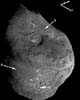
Painting by the numbers is a good description of how scientists create pictures of everything from atoms in our bodies to asteroids and comets in our solar system. Researchers involved in NASA's Deep Impact mission have been doing this kind of work since the mission's July 4th collision with comet Tempel 1. |
|
|

| The content herein, unless otherwise known to be public domain, are Copyright 1995-2006 - SpaceDaily.AFP and UPI Wire Stories are copyright Agence France-Presse and United Press International. ESA PortalReports are copyright European Space Agency. All NASA sourced material is public domain. Additionalcopyrights may apply in whole or part to other bona fide parties. Advertising does not imply endorsement,agreement or approval of any opinions, statements or information provided by SpaceDaily on any Web page published or hosted by SpaceDaily. Privacy Statement |