|
 |
 |
 |
 |
 |
 |
 |
 |

 |
Satellite Project On Track To Launch In 2003
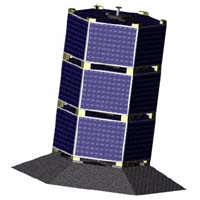
Las Cruces - Apr 29, 2002 A pioneering satellite project developed by New Mexico State University and two other western universities is scheduled to be launched from a NASA space shuttle in the summer of 2003, said Stephen Horan, a professor of electrical engineering at New Mexico State. The Three Corner Sat project, composed of three miniature "nanosatellites" was developed by New Mexico State, Arizona State University and the University of Colorado at Boulder. It is at Kirtland Air Force Base now undergoing a series of tests required for the space shuttle flight, Horan said. Horan said 10 U.S. universities began work on the University Nanosat Program, jointly sponsored by the Air Force, NASA and the Defense Advanced Research Projects Agency, but only the team composed of New Mexico State, Arizona State University and the University of Colorado-Boulder met the program's deadline of January 2002. "Our group was the only one that got construction complete, with approved materials, and ready for safety testing by the end of January," he explained. Horan said teamwork was the key to the group's success. "Of the other universities, two dropped out because they didn't want to fly in the shuttle, two were asked to work as a team, because they had a prior working relationship, and three were asked to work as a team after they received a contract with the program -- but each of them began the process with its own satellite design that it had to integrate with others at a later point," he said. "We were the only universities that began the process as a team. Our theory was that each of us should work on that area of the satellites where it was the strongest. Then we integrated those parts into one unified design. This was a major difference between us and the other groups and I know it meant we had a lot fewer problems," he said. Arizona State concentrated on the physical structure of the satellites, its solar cells and its on-board electrical system. The University of Colorado-Boulder built the cameras on the satellites, their flight computers and control software. At New Mexico State a group of staff members and students under Horan's guidance built the satellites' communications system. Built from commercially available parts familiar to any amateur radio operator, the communications system will allow the three satellites' software to communicate with Earth and between each satellite, Horan said. Once they are launched, the satellites are expected to fly together, using their software and the communications system to coordinate and to carry out activities such as taking three-dimensional pictures of cloud formations, he said. The constellation of tiny satellites will be monitored by all three universities, Horan said. "The central monitoring station will be in Boulder, but there will be two substations, one here and one in Tempe, Ariz. At New Mexico State, we are designing software that will link the monitoring stations to the Internet," he said. That software design is being carried out by Kendall Mauldin, a senior in electrical engineering, with the assistance of Michael Jourdan, also a senior in electrical engineering, Horan said. According to NASA and the Air Force, nanosatellites are the future of satellite technology. "Microsatellites can be more easily and more cheaply manufactured in greater numbers to reap 'economy of scale' benefits. Because they have less mass and are much lighter, launch costs drop off sharply by using smaller launch vehicles to carry more payload into orbit," said a recent news release from the Air Force Research Laboratory. "Redundant components for reliability, as well as spreading the gradual degradation of subsystems across the entire cluster rather than in just one large satellite, increase the odds for mission success. Also, the ability to rapidly reconfigure a satellite formation for shifting surveillance missions or taking wide-ranging scientific measurements, are advantages of microsatellite constellations," the release added. Community Email This Article Comment On This Article Related Links Three Corner Satellite SpaceDaily Search SpaceDaily Subscribe To SpaceDaily Express Space Technology News - Applications and Research
 NGC Chosen To Proceed With Developing Solid-State Laser Technology For Military Applications
 Redondo Beach CA (SPX) Jan 09, 2006
Northrop Grumman Corporation has been selected to develop "military-grade," solid-state laser technology that is expected to pave the way for the U.S. military to incorporate high-energy laser systems across all services, including ships, manned and unmanned aircraft, and ground vehicles. |
|
|

| The content herein, unless otherwise known to be public domain, are Copyright 1995-2006 - SpaceDaily.AFP and UPI Wire Stories are copyright Agence France-Presse and United Press International. ESA PortalReports are copyright European Space Agency. All NASA sourced material is public domain. Additionalcopyrights may apply in whole or part to other bona fide parties. Advertising does not imply endorsement,agreement or approval of any opinions, statements or information provided by SpaceDaily on any Web page published or hosted by SpaceDaily. Privacy Statement |