|
 |
 |
 |
 |
 |
 |
 |
 |

 |
Satellite Imagery Shows Extent Of Drought In East Africa
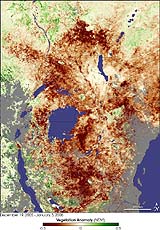
Greenbelt MD (SPX) Feb 01, 2006 The failure of the short-season rains have left large sections of East Africa in severe drought. In a normal year, rains fall from March to May during the long rainy season, and from October to December during the short rainy season. The rains recharge lakes and reservoirs and nurture plants -from crops and pasture lands to natural vegetation. For East Africa, 2005 was anything but a normal year. The long rainy season produced little rain, and the short rainy season failed altogether. As a result, rainfall totals for the year were only 20-60 percent of normal, depending on the region, reported the Famine Early Warning Network (FEWS NET). The drought's impact on vegetation can be seen in this image, collected at the end of the short rainy season. The image shows how well plants are growing compared to average conditions between 2000 and 2004. The prevalence of deep reddish-brown across the image indicates that plants are growing poorly, if at all, in the dry conditions. The drought area shown in this image circles Lake Victoria in a north-south-oriented oval that stretches from southern Sudan and Ethiopia in the north to Tanzania in the south. Grey areas show where clouds covered the area throughout the composite period. The impact of the drought has been severe. "This drought has resulted in crop failures, pasture degradation, water shortages, and has raised serious food security concerns for the region," FEWS NET warned. By the end of January 2006, millions were in need of food aid, particularly pastoralists who depend on rain-fed pasture lands to maintain their livestock. Not all of East Africa has been affected. Kenya (center right) had a bumper harvest in 2005, but little of the crop made its way to the drought-hit pastoral districts of the country. NASA image created by Jesse Allen, Earth Observatory, using data provided by Inbal Reshef as part of the Global Agricultural Monitoring Project between NASA, USDA's Foreign Agricultural Service (FAS), and the University of Maryland. More data and information about this joint project is available at Satellite Information for Agricultural Monitoring. Community Email This Article Comment On This Article Related Links - Earth Observation News - Suppiliers, Technology and Application
 The Cluster Active Archive Goes Online
 Paris (ESA) Feb 02, 2006
Today, 1 February 2006, exactly 5 years after the start of scientific operations on the four Cluster spacecraft, the Cluster Active Archive (CAA) goes online. CAA is the central depository of processed and validated high- and low-resolution Cluster data, raw data, processing software, calibration data, documentation and other value added products. CAA is a free system made available to the worldwide scientific community without any data right restrictions at. |
|
|

| The content herein, unless otherwise known to be public domain, are Copyright 1995-2006 - SpaceDaily.AFP and UPI Wire Stories are copyright Agence France-Presse and United Press International. ESA PortalReports are copyright European Space Agency. All NASA sourced material is public domain. Additionalcopyrights may apply in whole or part to other bona fide parties. Advertising does not imply endorsement,agreement or approval of any opinions, statements or information provided by SpaceDaily on any Web page published or hosted by SpaceDaily. Privacy Statement |