|
 |
 |
 |
 |
 |
 |
 |
 |

 |
Santa Barbara Researchers Light Up 'Dark' Spins In Diamond
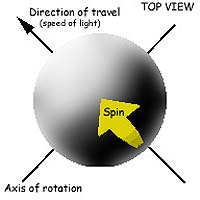
Santa Barbara CA (SPX) Nov 24, 2005 Researchers at UC Santa Barbara have potentially opened up a new avenue toward room temperature quantum information processing. By demonstrating the ability to image and control single isolated electron spins in diamond, they unexpectedly discovered a new channel for transferring information to other surrounding spins - an initial step towards spin-based information processing. Quantum information processing uses the remarkable aspects of quantum mechanics as the basis for a new generation of computing and secure communication. The spin of a particle is quantum mechanical in nature, and is considered a viable candidate to implement such technologies. A team of researchers including graduate students Ryan Epstein and Felix Mendoza, and their advisor, David Awschalom, a professor of physics, were intrigued by the long-lived electronic spins of so-called nitrogen-vacancy impurities in the diamond crystal � defects that only consist of two atomic sites. So, about two years ago, they embarked on developing a sensitive room temperature microscope that would allow them to study individual defects through their light emission. This microscope, with its unique precision in the control of the magnetic field alignment, has allowed them to not only detect individual nitrogen-vacancy defects, but also small numbers of previously invisible 'dark' spins from nitrogen defects in their vicinity. These spins are called 'dark' because they cannot be directly detected by light emission and yet, it appears that they may prove extremely useful. "We have found a channel for moving information between single electron spins at room temperature," said Awschalom. "This bodes well for making networks of spins, using the dark spins as wires, in order to process information at the atomic level." The paper, "Anisotropic interactions of a single spin and dark-spin spectroscopy in diamond," is being published by Nature Physics in November 2005, and is available through advance online publication. Community Email This Article Comment On This Article Related Links UCSB SpaceDaily Search SpaceDaily Subscribe To SpaceDaily Express Space Technology News - Applications and Research
 Industry Team Achieve New Communications Technology With AESA Radars
 Baltimore MD (SPX) Jan 12, 2006
A team comprised of three leading US aerospace and defense contractors has demonstrated an innovative technological use of active electronically scanned array (AESA) radars for high-bandwidth communications. |
|
|

| The content herein, unless otherwise known to be public domain, are Copyright 1995-2006 - SpaceDaily.AFP and UPI Wire Stories are copyright Agence France-Presse and United Press International. ESA PortalReports are copyright European Space Agency. All NASA sourced material is public domain. Additionalcopyrights may apply in whole or part to other bona fide parties. Advertising does not imply endorsement,agreement or approval of any opinions, statements or information provided by SpaceDaily on any Web page published or hosted by SpaceDaily. Privacy Statement |