|
 |
 |
 |
 |
 |
 |
 |
 |

 |
Sandia and General Atomics Develop New Synthetic-Aperture Radar
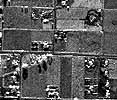
Albuquerque - September 1, 1999 - Lynx, a new fine resolution, real time synthetic-aperture radar (SAR) system, was unveiled here Saturday, Aug. 28 by the Department of Energy's Sandia National Laboratories and General Atomics of San Diego. On hand to introduce the new system at a ceremony in Albuquerque were U.S. Sen. Pete Domenici (R-N.M.); Neal Blue, CEO of General Atomics; and C. Paul Robinson, Sandia's president. Designed to be mounted on both manned aircraft and unmanned aerial vehicles (UAVs), the 115-pound SAR is a sophisticated all-weather sensor capable of providing photographic-like images through clouds, in rain or fog and in day or night conditions, all in real time. The SAR produces images of extremely fine resolution, far surpassing current industry standards for synthetic- aperture radar resolution. Depending on weather conditions and imaging resolution, the sensor can operate at a range of up to 85 kilometers. "The Lynx represents a breakthrough on many fronts," says Bill Hensley, Sandia project leader. "Because the image resolution is so fine and the instrument itself is so light-weight, it represents a technology breakthrough. The real time, interactive nature of the radar and the innovative operator interface, make it a breakthrough for meeting the ease-of-use needs of front-line military users. And because Sandia developed the technology and successfully transferred it to General Atomics, it is also a technology transfer success story." Mike Reed, Lynx program manager at General Atomics, said that Sandia and General Atomics joined forces in 1996 when the San Diego-based company, whose Aeronautical Systems, Inc. affiliate builds a line of unmanned aerial vehicles, wanted to develop an advanced, light-weight SAR system. General Atomics funded Sandia, which already had a sophisticated SAR, to implement an enhanced design as a commercial product and deliver two prototype units together with licenses and manufacturing information to produce the unit. General Atomics and Sandia spent the next three years working together to refine and enhance the national laboratories' SAR into a light-weight, user friendly system with extended range and much higher resolution. General Atomics has commenced production of subsequent units for commercial sales. The new SAR will enhance the surveillance capability of the General Atomics Aeronautical Systems UAVs and other reconnaissance aircraft, which previously were equipped only with cameras, infrared sensors and older generation SAR equipment. "Cameras provided good data, but they don't work at night or in rainy, foggy and cloudy situations," Hensley says. "Fine-resolution image SAR radar is perfect for these circumstances because it can 'see' in the dark and peer through clouds and fog." Flying at an altitude of 25,000 feet, the Lynx SAR can produce one-foot resolution imagery at standoff distances of up to 55 kilometers. At a resolution of four inches, the radar can make images of scenes which are 25 kilometers away (about 16 miles) even through clouds and light rain. The radar operates in Ku-band with a center frequency of about 16.7 GHz, although the precise value can be tuned to prevent interference with other emitters. Lynx introduces several new characteristics and functions. In addition to being very light weight, the radar can detect very small changes in a scene by using a technique called coherent change detection. It will also be able to detect moving targets. Sandia and General Atomics worked to make Lynx as much like an optical system to use as possible. The radar forms an image covering an area larger than that displayed, storing it in cache memory. This allows the operator to pan around within the total scene in order to concentrate on a particular area of interest. The radar's fine resolution allows it to detect small surface penetrations -- even footprints in a soft terrain. Lynx has been successfully flown for more than 140 hours on a DOE plane and on the General Atomics I-GNAT. In all testing, the SAR worked with the precision expected. General Atomics, founded in 1955, is involved in high-technology nuclear energy, commercial, and defense-related research and development. Affiliated manufacturing and commercial service companies include General Atomics Aeronautical Systems, Inc., which builds the family of Predator, GNAT, Prowler, and Altus unmanned aerial vehicles (UAVs). Sandia is a multiprogram laboratory operated by Sandia Corporation, a Lockheed Martin Company, for the United States Department of Energy under contract DE-AC04-94AL85000. With main facilities in Albuquerque, N.M., and Livermore, Calif., Sandia has major research and development responsibilities in national security, energy and environmental technologies, and economic competitiveness.
Radar Reports At SpaceDaily
Email This Article Comment On This Article Related Links Space
 Satellite Launch To Boost DTH In India
 Calcutta, India (SPX) Dec 28, 2005
The successful launch Thursday of India's heaviest satellite from spaceport of Kourou in French Guyana may have boosted the country's space research efforts to yet another level, but it has also lifted the spirits of at least three Direct-To-Home televisions broadcasters, one of which has been waiting for years to launch its services in India. |
|
|

|
|
|
|
|
|
|
|
|
|
|
|
| The content herein, unless otherwise known to be public domain, are Copyright 1995-2006 - SpaceDaily.AFP and UPI Wire Stories are copyright Agence France-Presse and United Press International. ESA PortalReports are copyright European Space Agency. All NASA sourced material is public domain. Additionalcopyrights may apply in whole or part to other bona fide parties. Advertising does not imply endorsement,agreement or approval of any opinions, statements or information provided by SpaceDaily on any Web page published or hosted by SpaceDaily. Privacy Statement |