|
 |
 |
 |
 |
 |
 |
 |
 |

 |
San Andreas Quakes Have Almost Always Been Big Ones: Paleoseismologists
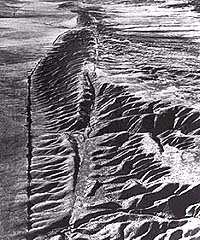
Pasadena CA (SPX) Jul 23, 2004 A common-sense notion among many Californians is that frequent small earthquakes allow a fault to slowly relieve accumulating strain, thereby making large earthquakes less likely. New research suggests that this is not the case for a long stretch of the San Andreas fault in Southern California. In a study appearing in the current issue of the journal Geology, researchers report that about 95 percent of the slippage at a site on the San Andreas fault northwest of Los Angeles occurs in big earthquakes. By literally digging into the fault to look for information about earthquakes of the past couple of millennia, the researchers have found that most of the motion along this stretch of the San Andreas fault occurs during rare but large earthquakes. "So much for any notion that the section of the San Andreas nearest Los Angeles might relieve its stored strains by a flurry of hundreds of small earthquakes!" said Kerry Sieh, a geology professor at the California Institute of Technology and one of the authors of the paper. Sieh pioneered the field of paleoseismology years ago as a means of understanding past large earthquakes. His former student, Jing Liu, now a postdoctoral fellow in Paris, is the senior author of the paper. In this particular study, Liu, Sieh, and their colleagues cut trenches parallel and perpendicular to the San Andreas fault at a site 200 kilometers (120 miles) northwest of Los Angeles, between Bakersfield and the coast. The trenches allowed them to follow the subsurface paths of small gullies buried by sediment over the past many hundreds of years. They found that the fault had offset the youngest channel by nearly 8 meters, and related this to the great (M 7.9) earthquake of 1857. Older gullies were offset progressively more by the fault, up to 36 meters. By subtracting each younger offset from the next older one, the geologists were able to recover the amount of slip in each of the past 6 earthquakes. Of the six offsets discovered in the excavations, three and perhaps four were offsets of 7.5 to 8 meters, similar in size to the offset during the great earthquake of 1857. The third and fourth events, however, were slips of just 1.4 and 5.2 meters. Offsets of several meters are common when the rupture length is very long and the earthquake is very large. For example, the earthquake of 1857 had a rupture length of about 360 kilometers (225 miles), extending from near Parkfield to Cajon Pass. So, the five events that created offsets measuring between 5.2 and 8 meters likely represent earthquakes that had very long ruptures and magnitudes ranging from 7.5 to 8. Taken together, these five major ruptures of this portion of the San Andreas fault account for 95 percent of all the slippage that occurred there over the past thousand years or so. The practical significance of the study is that earthquakes along the San Andreas, though infrequent, tend to be very large. Years ago, paleoseismic research showed that along the section of the fault nearest Los Angeles the average period between large earthquakes is just 130 years. Ominously, 147 years have already passed since the latest large rupture, in 1857. The other authors of the paper are Charles Rubin, of the department of geological sciences at Central Washington University in Ellensburg, and Yann Klinger, of the Institut de Physique du Globe de Paris, France. Community Email This Article Comment On This Article Related Links Caltech SpaceDaily Search SpaceDaily Subscribe To SpaceDaily Express Tectonic Science and News
 Ash Continuing To Spew From Vanuatu Volcano
 Sydney (AFP) Dec 12, 2005
Thousands of tonnes of ash are continuing to spew from a volcano in Vanuatu, but officials said Monday the activity on the South Pacific nation was not likely to result in a major deadly eruption. |
|
|

| The content herein, unless otherwise known to be public domain, are Copyright 1995-2006 - SpaceDaily.AFP and UPI Wire Stories are copyright Agence France-Presse and United Press International. ESA PortalReports are copyright European Space Agency. All NASA sourced material is public domain. Additionalcopyrights may apply in whole or part to other bona fide parties. Advertising does not imply endorsement,agreement or approval of any opinions, statements or information provided by SpaceDaily on any Web page published or hosted by SpaceDaily. Privacy Statement |