Energy News  
Sampling 'Small Atmospheres' In The Tiny New Worlds Of MEMS

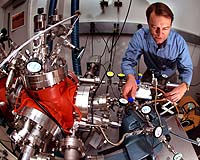
Sandia National Laboratories researcher Steve Thornberg arranges picopuffs of gases from crushed MEMS devices to be sampled by his group's unique analytic device. Photo by Randy Montoya.

Albuquerque NM (SPX) Mar 09, 2005
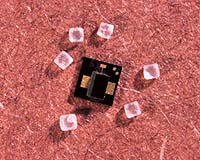
Just as astronomers want to understand the atmospheres of planets and moons, so engineers want atmospheric knowledge of worlds they create that are the size of pinheads, their "skies" capped by tiny glass bubbles.

Should their silicon inhabitants - microcircuits, microgears, and micropower drivers - exist in a vacuum? An atmosphere of nitrogen? Air as we know it? More importantly, whatever atmosphere was intended, how long will it stay that way?

Is the protective barrier hermetic or will its atmosphere change over time, potentially leading to the early death of the device?

Will water vapor seep in, its sticky molecules causing unpredictable behavior? What, in short, can we say about how long this little world and its inhabitants will survive and function?

The most advanced sampling procedure known - requiring only picoliters of gas to evaluate the contents of these small atmospheres - is now in place at Sandia National Laboratories, a National Nuclear Security Administration facility. The method was recently revealed at the SPIE Photonics Meeting in San Jose, Calif.

"I know of no one, anywhere else, who can do this kind of testing," says Sandia innovator Steve Thornberg.

John Maciel agrees. Chief Operating Officer of Radant MEMS, a three-year-old start-up company in Stow, Mass., he is under contract with DARPA to develop high-reliability MEMS (microelectromechanical) switches for microwave devices and phased array antennas. He also sees markets for his MEMS switches in cell phones.

For long-term reliability, small-atmosphere stability is a must. "We can't go to a commercial house to get this work done," he says. "We can't find the capability anywhere else but Sandia."

The Sandia method - funded by its Laboratory-Directed Research and Development program, and presented for consideration to Sandia's patent office - involves a small commercial valve that comes down like a trash compactor and crushes a tiny device until it releases its gases - currently, about 30 nanoliters - into a custom-built intake manifold.

Because Thornberg's test mechanism requires only picoliters, his sensitive device can recheck its own measurements - using bursts of gas delivered in a series of puffs - dozens of times from the same crushed device in a 20-minute time span.


Community
Email This Article
Comment On This Article

Related Links
Sandia National Laboratories
SpaceDaily
Search SpaceDaily
Subscribe To SpaceDaily Express
Nano Technology News From SpaceMart.com
Computer Chip Architecture, Technology and Manufacture


Memory Foam Mattress Review
Newsletters :: SpaceDaily :: SpaceWar :: TerraDaily :: Energy Daily
XML Feeds :: Space News :: Earth News :: War News :: Solar Energy News


Prof Develops Cancer Nanobomb
Newark DE (SPX) Oct 14, 2005
University of Delaware researchers are opening a new front in the war on cancer, bringing to bear new nanotechnologies for cancer detection and treatment and introducing a unique nanobomb that can literally blow up breast cancer tumors.


  • LHC Magnets: The Great Descent
  • DayStar Technologies Unveils LightFoil Photovoltaic Product For U.S. Military
  • EU Gives Japan Until June To Reach Deal On Nuclear Project
  • Consigned To Cern The Last Component Of Cms Solenoid

  • New Nuclear Friction In West
  • Iran Says Ready To Sign Key Deal With Russian On Nuclear Plant
  • Tsunami Makes India's Nuke Workers Jittery
  • Japan Begins Controversial Uranium Test To Recycle Nuclear Fuel


  • NASA Uses Remotely Piloted Airplane To Monitor Grapes


  • Airbus, Space Activities Lift EADS 2004 Profit By 60 Percent
  • Fossett Commits To Final Dash To Kansas
  • GlobalFlyer Approaches Pakistan In Round-The-World Flight
  • NASA Developed Tools For Successful Air Travel Program

  • NASA plans to send new robot to Jupiter
  • Los Alamos Hopes To Lead New Era Of Nuclear Space Tranportion With Jovian Mission
  • Boeing Selects Leader for Nuclear Space Systems Program
  • Boeing-Led Team to Study Nuclear-Powered Space Systems

  • The content herein, unless otherwise known to be public domain, are Copyright 1995-2006 - SpaceDaily.AFP and UPI Wire Stories are copyright Agence France-Presse and United Press International. ESA PortalReports are copyright European Space Agency. All NASA sourced material is public domain. Additionalcopyrights may apply in whole or part to other bona fide parties. Advertising does not imply endorsement,agreement or approval of any opinions, statements or information provided by SpaceDaily on any Web page published or hosted by SpaceDaily. Privacy Statement