|
 |
 |
 |
 |
 |
 |
 |
 |

 |
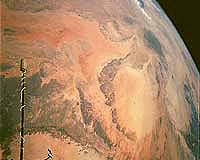
Sahara Desert And Amazon Basin - Achilles' Heels In Earth's Armour
Stockholm, Sweden (SPX) Sep 06, 2004 What do the Amazon Basin and Sahara Desert have in common? They are intricately linked by dust and climate and both belong to a family of hotspots or "Achilles' heels" that have a profound impact on the global environment, says Professor John Schellnhuber, who spoke at the EuroScience Forum in Stockholm between August 25-28. Dust from the Sahara Desert fertilises the Amazon, increasing the abundance of life there, says Professor Schellnhuber, IGBP Science Ambassador and Director of the UK-based Tyndall Climate Centre. "This process has been going on for thousands of years and is one reason why the Amazon Basin teems with life". Both regions are also being affected by climate change, though in opposite ways. It is predicted that global warming will reduce rainfall in the region initiating a major dieback of the forests in the Amazon. Once begun, this process will be extremely difficult, if not impossible, to reverse. Deforestation through human land use is also exacerbating the process. For the Sahara, though, current climate models predict that global warming could trigger a greening of the desert, reducing the amount of dust that it produces. "This creates the peculiar and disturbing prospect that one day the relationship between the Sahara and the Amazon could be reversed, though wind currents will probably make a different part of the world the beneficiary of Amazonian dust," says Schellnhuber. Human behaviour is also directly influencing the ancient relationship between the two regions. Four-wheel drive vehicles are churning up the Sahara Desert causing a surge in the amount of dust produced. This sounds like a good thing for the Amazon, and in the long run the extra dust may offset the impact of a greening of the desert. "On the other hand, global dust is becoming a major problem in terms of climate change," he says. "As with many regions of the world, we don't know which areas will be 'winners' and which will be 'losers'. My sense is that the Amazon will be a major loser". The relationship between the Amazon and Sahara illustrates the complexity and intertwined nature of the Earth System and draws attention to another affiliation between the two regions - both belong to a family of "hotspots" that act like massive regulators of Earth's environment, says Professor Schellnhuber. They are amongst a dozen such hotspots that scientists have located so far. According to Schellnhuber, these hotspots (also known amongst scientists as Earth's "Achilles' heels"), are critical regions of the Earth that, if stressed, could trigger large-scale rapid changes across the entire planet. A good example is the North Atlantic Current, the ocean circulation pattern responsible for bringing warmer air to northern Europe. The collapse of this current could lead to a massive regional shift in climate. Other examples include the Asian monsoon system and the West Antarctic Ice Sheet. Professor Schellnhuber likens these spots to vital organs in the body. "The Earth is in many ways similar to a human body. All parts of the planet are interconnected and, just like the heart, lungs and brain etc, the "vital organs" of the Earth must be kept in good health," he says. However, not enough is known about these vital points to be able to predict when critical thresholds are reached. "We have so far completely underestimated the importance of these locations. What we do know is that going beyond critical thresholds in these regions is could have dramatic consequences for humans and other life forms". Professor Schellnhuber calls for a coordinated global effort to better understand and monitor the Earth's "Achilles' heels". "Such an effort is every bit as important as NASA's valuable asteroid spotting programme designed to protect the planet from collisions," he says. "If we can afford to gaze up at the sky looking for asteroids, we should be able to watch our own planet with as much care". Community Email This Article Comment On This Article Related Links International Geosphere-Biosphere Programme Tyndall Centre for Climate Change Research SpaceDaily Search SpaceDaily Subscribe To SpaceDaily Express Earth Observation News - Suppiliers, Technology and Application
 New Legislation Initiated To Support Commercial Remote Sensing Industry
 New York NY (SPX) Jan 11, 2006
The importance of remotely sensed data and technologies to support natural disasters has prompted attention and action in Washington. New initiatives and legislation authorizing appropriations to the remote sensing industry will be discussed at Strategic Research Institute's U.S. Commercial Remote Sensing Industry conference, scheduled for February 9-10, 2006 in Washington D.C. |
|
|

| The content herein, unless otherwise known to be public domain, are Copyright 1995-2006 - SpaceDaily.AFP and UPI Wire Stories are copyright Agence France-Presse and United Press International. ESA PortalReports are copyright European Space Agency. All NASA sourced material is public domain. Additionalcopyrights may apply in whole or part to other bona fide parties. Advertising does not imply endorsement,agreement or approval of any opinions, statements or information provided by SpaceDaily on any Web page published or hosted by SpaceDaily. Privacy Statement |