|
 |
 |
 |
 |
 |
 |
 |
 |

 |
Safer Navigation Means More Helicopters Saving Lives
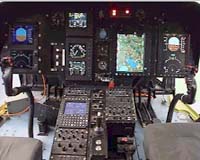
Paris (ESA) Apr 22, 2003 Although most modern helicopters have Instrumental Flight Rules (IFR) capability this is not used because IFR are not adapted to helicopter flight characteristics. As a result almost all medical operations are still performed under Visual Flight Rules (VFR). When visibility is reduced, as in bad weather, the use of VFR creates a risk factor in helicopter medical operations. Any helicopter landing system must support steep glide slopes and multiple legs but needs little or no ground infrastructure. This rules out the conventional Instrument Landing system meaning that systems relying on the Global Navigation Satellite System (GNSS) are required instead. There are currently three options: GPS, EGNOS and ground-based augmentation systems (GBAS). Of these, EGNOS is the most appropriate for Europe because it delivers a high level of performance and needs no local ground installation. EGNOS (the European Geostationary Navigation and Overlay Service) is a joint project of the European Space Agency (ESA), the European Commission (EC) and Eurocontrol, the European Organisation for the Safety of Air Navigation. It is designed to augment the two military satellite navigation systems now operating (US GPS and Russian GLONASS) and is paving the way for Galileo. The system, now in its testbed phase and operational in 2004, already improves the accuracy of GPS positions from about 20m to 2m. A very successful demonstration was organised by Eurocopter last month as part of a programme to improve the ability of helicopters to fly in adverse weather. These trials validated the use of EGNOS on HEMS helicopters. Eurocopter fitted an EGNOS Test Bed User Equipment (TBUE) receiver onto an EC 155-HTT helicopter. This was coupled with the flight management system (FMS) so that EGNOS-guided helicopter approaches could be shown. These trials demonstrated the good quality of the EGNOS signal despite the adverse electromagnetic environment that is typical to helicopters because of the rotating blades and other masking effects. The TBUE receiver successfully enabled precise guidance, both in manual and automatic piloting mode. The flight path simulated a medical mission, including approaches and transition to hover before final landing. EGNOS can deliver real benefits to the Helicopter Emergency Services (HEMS) helicopters by bringing helicopter IFR approaches to reality. There will be less noise at ground level, and it should be safer to fly in adverse weather conditions. Crucially, a more reliable service with fewer cancelled flights means more lives saved. Community Email This Article Comment On This Article Related Links ESA's Navigation homepage EGNOS System Test Bed (ESTB) Galileo website at European Commission Eurocopter SpaceDaily Search SpaceDaily Subscribe To SpaceDaily Express GPS Applications, Technology and Suppliers
 Galileo GIOVEA Using Marotta Equipment For Its Propulsion Systems
 Cheltenham, England (SPX) Jan 09, 2006
Marotta UK is pleased to announce that it designed, developed and qualified equipment for the cold gas propulsion systems on board the Galileo GIOVE-A, part of Europe's Galileo navigation program, successfully launched by Surrey Satellite Technology (SSTL). |
|
|

| The content herein, unless otherwise known to be public domain, are Copyright 1995-2006 - SpaceDaily.AFP and UPI Wire Stories are copyright Agence France-Presse and United Press International. ESA PortalReports are copyright European Space Agency. All NASA sourced material is public domain. Additionalcopyrights may apply in whole or part to other bona fide parties. Advertising does not imply endorsement,agreement or approval of any opinions, statements or information provided by SpaceDaily on any Web page published or hosted by SpaceDaily. Privacy Statement |