Energy News  
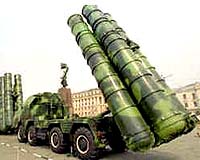
S-400 System Deployment Postponed Says Russian

The system is highly capable of destroying stealth aircraft, cruise missiles and ballistic missiles with an effective range of up to 3,500 kilometers (2,200 miles) and a speed of up to 4.8 kilometers (3 miles) per second.

Russia's Missile Forces to test launch Voyevoda ICBMs
Moscow (RIA Novosti) - Russia's Strategic Missile Forces are preparing two test launches of heavy R-36M2 Voyevoda (SS-18 Satan) intercontinental ballistic missiles, the forces' commander said Tuesday. "Preparation of these launches from the Baikonur space center is proceeding according to plan, and I think these launches will be successfully made in due time," Colonel-General Nikolai Solovtsov told journalists. Solovtsov said the forces planned a number of test launches of ICBMs this year, including from the Plesetsk space center and Kapustin Yar testing range. "All launches are of a multitask nature," he said, adding that the tasks could include testing new types of missile systems that could in the future be adopted by the forces. Russia leases the Baikonur space center from Kazakhstan.
by Staff Writers
Moscow (RIA Novosti) Jun 13, 2007
S-400 missile defense systems (NATO codename SA-21 Growler) will be deployed later that previously expected, the commander of Russia's Air Force said Tuesday. "The deployment of the new S-400 missile defense system is postponed due to objective reasons," Colonel-General Alexander Zelin said, without mentioning the exact reasons. He added that S-400 will certainly be deployed in summer.

Earlier it was reported the first S-400 systems were to be deployed July 1, 2007.

The S-400 Triumf is a new air defense missile system developed by the Almaz Central Design Bureau as an upgrade of the S-300 family.

It has been designed to intercept and destroy airborne targets at a distance of up to 400 kilometers (250 miles), or twice the range of the MIM-104 Patriot, and 2.5 times that of the S-300PMU-2.

In April, Colonel-General Yury Solovyov, commander of the Air Defense Forces Special Command (former Moscow Military District Air Defense Command), said the system could also be used for limited purposes in missile and space defense, but that it is not intended to destroy intercontinental ballistic missiles.

However, he said the system is highly capable of destroying stealth aircraft, cruise missiles and ballistic missiles with an effective range of up to 3,500 kilometers (2,200 miles) and a speed of up to 4.8 kilometers (3 miles) per second.

The Russian Air Defense Forces, which are part of the Air Force, currently deploy more than 30 regiments equipped with S-300 missile complexes, which will be gradually replaced with S-400 systems.

Email This Article

Related Links

Almaz Central Design Bureau
Learn about nuclear weapons doctrine and defense at SpaceWar.com
Learn about missile defense at SpaceWar.com
All about missiles at SpaceWar.com
Learn about the Superpowers of the 21st Century at SpaceWar.com

Putin Is Not Joking On Missiles Cautions Ukrainian President
Montreal (AFP) June 12, 2007
Ukrainian President Viktor Yushchenko said in an interview he took seriously Russian President Vladimir Putin's recent threat to point missiles at Europe. "I think the President of Russia is not kidding," Yushchenko said in an interview published Tuesday by The Globe and Mail. He was referring to Putin's threat to aim Russia's missiles at European cities if elements of a US missile shield were put in the Czech Republic and Poland.


  • Green Coffins Go Upmarket At British Funeral Parlors
  • Researchers Examine Carbon Capture And Storage To Combat Global Warming
  • Tennessee Residents Favor Expanded Wind Energy
  • New Green Pyre To Cool Planet While Burning The Dead Of India

  • Wyle And ARES Corporation Sign Teaming Agreement To Pursue Nuclear Energy Industry Business
  • NGO Warns Of Explosion Risk At Russian Nuclear Storage
  • US Sees Technical Delay In India Nuclear Pact
  • US Positive On Clinching India Nuclear Accord

  • AIRS Global Map Of Carbon Dioxide From Space
  • Widespread Twilight Zone Detected Around Clouds
  • Rand Says Further Study Warranted On Save The World Air Technology
  • Noxious Lightning

  • Woods Hole Research Center Scientists Study Impacts Of Industrial Logging In Central Africa
  • Zimbabwe Forests Under Threat While Cambodia Censors Logging Report
  • Uganda Shelves Plan To Convert Rainforest
  • Indonesia's Crackdown On Illegal Logging Under Fire

  • A Crop Containment Strategy For GM Farms
  • Study Predicts Grim Future For European Seas
  • Compost Reduces P Factor In Broccoli, Eggplant, Cabbage Trial
  • Wild Relatives Sweeten Breeding Program

  • GM Wants To Drive Green But Easy On The Rules
  • PSEG To Replace 1300 Vehicles with Hybrids To Help Curb Carbon Emissions In New Jersey
  • Toyota Taken To Task In Britain For Prius Advert
  • GM To Speed Up Development Of Electric Vehicles

  • Airlines Pledge Emissions Cuts But Warn EU Curbs Could Jeopardise Sector
  • Sandia And Boeing Collaborate To Develop Aircraft Fuel Cell Applications
  • Australia Fears Jet Flight Guilt Could Hit Tourism
  • Nondestructive Testing Keeps Bagram Aircraft Flying

  • Could NASA Get To Pluto Faster? Space Expert Says Yes - By Thinking Nuclear
  • NASA plans to send new robot to Jupiter
  • Los Alamos Hopes To Lead New Era Of Nuclear Space Tranportion With Jovian Mission
  • Boeing Selects Leader for Nuclear Space Systems Program

  • The content herein, unless otherwise known to be public domain, are Copyright 1995-2006 - SpaceDaily.AFP and UPI Wire Stories are copyright Agence France-Presse and United Press International. ESA PortalReports are copyright European Space Agency. All NASA sourced material is public domain. Additionalcopyrights may apply in whole or part to other bona fide parties. Advertising does not imply endorsement,agreement or approval of any opinions, statements or information provided by SpaceDaily on any Web page published or hosted by SpaceDaily. Privacy Statement