|
 |
 |
 |
 |
 |
 |
 |
 |

 |
SWAN observes fading sunspots on the back side of the Sun
Paris (ESA) Nov 20, 2003 The new Lyman-alpha method to monitor the activity of sunspots when they are on the far side of the Sun has been recently applied to a duo of giant sunspots number 486 and 488. The SWAN team (Jean-Loup Bertaux and Eric Quemerais) has found that their activity has decreased significantly in the last few days. These giant active regions were facing the Earth around October 28, when an intense Coronal Mass Ejection (CME) sent giant clouds of energetic particles (protons) out into the solar system. This affected many spacecraft, including the Mars Express ESA mission currently cruising towards Mars, for an encounter on 25 December. Star trackers on the Mars Express spacecraft could not be used for a period of time because of the effect of these high energy protons, accelerated in the shock front produced when the fast solar wind plasma of the CME bumps into the standard slower solar wind. Instead of identifying some stars in the field of view of the star tracker (which can be viewed as quite similar to a standard digital camera with a so-called CCD detector), the images are looking more like a heavy snowstorm. Mars Express survived this intense episode of solar activity easily, but there was some concern about the possible repetition of such an event, when the same sunspots 486 and 488 would come around on the Sun's east limb to face the Earth and Mars Express again. Due to the 27 days solar rotation, the two sunspots disappeared from direct view around November 4, and are reappearing today on the east limb of the Sun.
Observing the far side of the Sun with SWAN
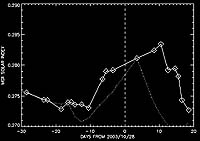
SWAN sees decreasing activity Using SWAN data scientists can measure what the evolution of this MgII index would be for an observer rotating with the Sun, who would always face the active region during the solar rotation. The MgII index found by SWAN was still increasing after October 28 up to the peak value of 0.283, which was reached on November 7. Since then it has been rapidly decreasing down to 0.273 on November 15. The corresponding decrease of the solar Lyman-alpha brightness found by SWAN was 20%. This is the sign that the activity of the two sunspots 486 and 488 has significantly decreased since their maximum value, reducing also (but not to zero) the probability of a new episode of solar storm as the one experienced on October 28. More generally, the SWAN method of monitoring the far side of the Sun allows a better forecast of the upcoming solar activity and associated Space Weather, which could present a danger to many space activities, and several ground based activities as well. Community Email This Article Comment On This Article Related Links Space Weather at ESA SOHO at ESA SpaceDaily Search SpaceDaily Subscribe To SpaceDaily Express Solar Science News at SpaceDaily
 Spacecraft Pick Up Earthly Aurora
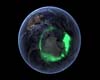 Greenbelt MD (SPX) Sep 20, 2005
A coronal mass ejection (CME) hit Earth's magnetic field on Sept. 15, but it did not spark the strong display of auroras many people were hoping to see. In the CME's wake, however, a fast solar wind stream is blowing past Earth and buffeting our planet's magnetic field. |
|
|

| The content herein, unless otherwise known to be public domain, are Copyright 1995-2006 - SpaceDaily.AFP and UPI Wire Stories are copyright Agence France-Presse and United Press International. ESA PortalReports are copyright European Space Agency. All NASA sourced material is public domain. Additionalcopyrights may apply in whole or part to other bona fide parties. Advertising does not imply endorsement,agreement or approval of any opinions, statements or information provided by SpaceDaily on any Web page published or hosted by SpaceDaily. Privacy Statement |