
 |
 |
 |
 |
 |
 |
 |
 |
 |

 |

London, UK (SPX) Apr 26, 2011 Researchers have discovered 122 new eclipsing binary stars and observed hundreds more variable stars in an innovative survey using NASA's two STEREO solar satellites. The survey has been carried out by team from the Open University, University of Central Lancashire and the STFC Rutherford Appleton Laboratory. Dr Danielle Bewsher will present highlights at the RAS National Astronomy Meeting in Llandudno, Wales. STEREO was launched in 2006 to study the Sun in 3D and coronal mass ejections, the cause of space weather. Each STEREO spacecraft carries a Heliospheric Imager (HI), each instrument comprising two cameras (HI-1 and HI-2) built and developed at the STFC's Rutherford Appleton Laboratory and the University of Birmingham. The HI cameras are able to make such stable measurements that researchers can accurately monitor the brightness of stars in the background. "Although STEREO is primarily a solar mission, we recognised that the stability of the HI cameras could also be used to monitor variations of the brightness of stars," said Bewsher, of the University of Central Lancashire. "To date, 893 000 stars have passed through the HI-1 field-of-view alone, producing an unexpected resource of scientific data about the variability of stars that is currently being data mined." The lead author, Karl Wraight, an STFC PhD student at the OU, has found the 122 new eclipsing binaries during an initial analysis of the data, and expects many more to be discovered. "STEREO's ability to sample continuously for up to 20 days, coupled with repeat viewings from the twin spacecraft during the year, makes it an invaluable resource for researching variable stars. As well as making discoveries, observations from HI are enabling us to pin down the periods of known variables with much greater accuracy," said Wraight. In addition to studying variable stars, the team believes that HI measurements may be used for exoplanet and astroseismology research. "Very small changes to the brightnesses of stars can be detected, which could reveal the presence of transiting exoplanets, or be used to trace a star's internal structure by measuring their seismic activity," said Professor Glenn White (RAL and OU).
Share This Article With Planet Earth
Related Links Royal Astronomical Society Stellar Chemistry, The Universe And All Within It

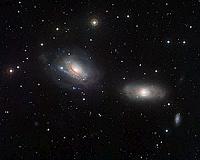 A Disturbed Galactic Duo
Paris, France (SPX) Apr 25, 2011 The galaxies in this cosmic pairing, captured by the Wide Field Imager on the MPG/ESO 2.2-metre telescope at the La Silla Observatory in Chile, display some curious features, demonstrating that each member of the duo is close enough to feel the distorting gravitational influence of the other. The gravitational tug of war has warped the spiral shape of one galaxy, NGC 3169, and fragmented t ... read more |
|
|
| The content herein, unless otherwise known to be public domain, are Copyright 1995-2010 - SpaceDaily. AFP and UPI Wire Stories are copyright Agence France-Presse and United Press International. ESA Portal Reports are copyright European Space Agency. All NASA sourced material is public domain. Additional copyrights may apply in whole or part to other bona fide parties. Advertising does not imply endorsement,agreement or approval of any opinions, statements or information provided by SpaceDaily on any Web page published or hosted by SpaceDaily. Privacy Statement |


 del.icio.us
 Digg
Digg Reddit
 YahooMyWeb
 Google
 Facebook


