|
 |
 |
 |
 |
 |
 |
 |
 |

 |
SSTL Readies First DMC Satellite For November Launch
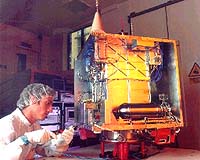
Guildford - Nov 25, 2002 AlSAT-1, the first satellite in the international Disaster Monitoring Constellation (DMC) led by SSTL, has arrived today at the Plesetsk Cosmodrome to be prepared for a 28 November launch. The 90kg enhanced microsatellite is Algeria's first national satellite and has been designed and constructed by SSTL at the Surrey Space Centre (UK) within a collaborative programme with the Algerian Centre National des Techniques Spatiales (CNTS). AlSAT-1 is part of a wider international collaboration to launch the first constellation of Earth observation satellites specifically designed for disaster monitoring. The AlSAT-1 enhanced microsatellite carries specially- designed Earth imaging cameras which provide 32-metres resolution imaging in 3 spectral bands (NIR, red, green) with an extremely wide imaging swath of 600km on the ground that enables a revisit of the same area anywhere in the world at least every 4 days with just a single satellite. AlSAT-1 is the first satellite in the Surrey-led Disaster Monitoring Constellation (DMC) which will comprises 5 microsatellites in low Earth orbit by the end of 2003. A joint British-Algerian team of SSTL & CNTS engineers successfully completed the manufacture and pre-flight testing of the enhanced microsatellite during a 15-month programme which included know-how training for the 11 Algerian engineers and scientists at SSTL in England. A mission control groundstation has also been installed by SSTL at CNTS in Algeria and engineers are carrying out final checks there in readiness for the launch. Earlier this month, AlSAT-1 left SSTL on its journey from the UK, via Moscow, to the Plesetsk Cosmodrome in northern Russia where it is now being readied for launch on a Kosmos 3-M rocket. A joint SSTL & Algerian team has travelled to Plesetsk to prepare the spacecraft for launch -- scheduled for 0700 GMT on 28th November 2002 into a 686km sun-synchronous orbit. The launch, which has been arranged by SSTL for CNTS, is being provided by Rosoboronexport in conjunction with the Russian Space Agency, Polyot and the Russian Space Forces. In mid-2003, following the validation of AlSAT-1 in orbit after launch, a further 4 microsatellites will be launched into the same orbit as AlSAT-1 to complete the constellation and provide a daily imaging revisit capability worldwide. SSTL is building these microsatellites in collaboration with Nigeria, Turkey & the UK. SSTL is also leading a follow-on DMC-2 constellation, including higher spatial resolution down to 2.5-metres GSD panchromatic and 5-metres multispectral, in collaboration with China, Thailand, UK & Vietnam with a first launch into the same orbit already arranged for mid-2004. The Disaster Monitoring Constellation (DMC) is a remarkable example of international collaboration in space. The concept of the DMC, whereby each satellite in the constellation is built & owned by an individual organisation but launched into the same orbit and operated co-operatively, was conceived and first presented in 1996 by SSTL at the International Astronautical Federation (IAF) Congress held in Beijing. This novel form of collaboration enables smaller organisations to achieve the benefits of a constellation of satellites in orbit whilst at the same time maintaining independent ownership and low cost. The DMC will be the world's first civilian Earth Observation (EO) constellation to provide a daily imaging revisit capability of this resolution anywhere on the Earth's surface. Led by SSTL, seven organisations from Africa, Asia and Europe have formed a "DMC Consortium" and agreed to contribute microsatellites into the constellation. The DMC Consortium comprises a partnership between organisations in Algeria, China, Nigeria, Thailand, Turkey, Vietnam and the United Kingdom. The objective of the Consortium is to derive the maximum mutual benefit from the constellation through collaboration and cooperation between the DMC partners. The international partners in the DMC Consortium have agreed to exchange their DMC satellite resources and data to achieve a daily Earth observation imaging capability for disaster monitoring and other dynamic phenomena as well as for national and commercial applications. Each year natural and man-made disasters around the world cause devastation, loss of life, widespread human suffering and huge economic losses. Images of disaster- stricken areas are often made available too late to be of real use to relief co-ordination agencies on the ground as current Earth observation satellites offer only infrequent image revisits and the delivery of critical information may take months due to periodic cloud cover and tasking conflicts. Due to its daily imaging revisit capability, the DMC will provide a service that will greatly improve the response time to aid the management and mitigation of disasters whenever, and wherever, they occur. The processed images from the DMC satellites will be distributed to relief teams on the ground by the Reuters AlterNet Foundation -- formed in 1997 to help the work of relief professionals around the world. The DMC has been made possible - and affordable -- by the highly capable microsatellites developed by Surrey that provide high quality multispectral imaging at a small fraction of the cost of a conventional satellite, thus making the constellation and this humanitarian service actually practicable.
The follow-on DMC-2 constellation, including higher spatial resolution down to 2.5-metres GSD panchromatic and 5-metres multispectral, is being prepared by SSTL in collaboration with China, Thailand, UK & Vietnam -- with a first launch into the same orbit already arranged for mid-2004. The first 2.5-metre resolution microsatellite is already under construction at SSTL whilst the Chinese and Vietnamese satellites are in the final stages of contract negotiation with SSTL. Community Email This Article Comment On This Article Related Links Surrey Satellite Technology Limited SpaceDaily Search SpaceDaily Subscribe To SpaceDaily Express Microsat News and Nanosat News at SpaceMart.com
 Small Satellite Solutions From Scotland
 Clyde, Scotland (SPX) Jan 12, 2006
Clyde Space are offering the growing ranks of small satellite manufacturers power subsystem solutions for their missions. Based in purpose built facilities on West of Scotland Science Park in Glasgow, Clyde Space has a range of power subsystems for missions from as little as 1W up to in excess of 2.5kW. |
|
|

| The content herein, unless otherwise known to be public domain, are Copyright 1995-2006 - SpaceDaily.AFP and UPI Wire Stories are copyright Agence France-Presse and United Press International. ESA PortalReports are copyright European Space Agency. All NASA sourced material is public domain. Additionalcopyrights may apply in whole or part to other bona fide parties. Advertising does not imply endorsement,agreement or approval of any opinions, statements or information provided by SpaceDaily on any Web page published or hosted by SpaceDaily. Privacy Statement |