
 |
 |
 |
 |
 |
 |
 |
 |
 |

 |
SSTL Completes Galileo In-Orbit Test Campaign
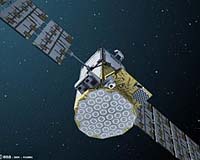
Guildford, UK (SPX) Sep 10, 2008 SSTL has completed an in-orbit test campaign analysing signals from the new GIOVE-B satellite for ESA. The results suggest that GIOVE-B is operating well and in turn validates technologies integral to the EU-funded Galileo Satellite Navigation project. "Having conducted several in-orbit test campaigns for GIOVE-A, ESA invited the SSTL team to support their GIOVE-B in-orbit test campaign. We are delighted to contribute to this further Galileo milestone," commented Elizabeth Rooney, SSTL's GIOVE project manager. During May and June SSTL's Galileo team processed data acquired by the Science and Technology Facilities Council (STFC) at its 25m dish in Chilbolton to analyse the centre frequency, signal power and structure of all three Galileo signals. The team validated the in-orbit signals, which met expectations and correlated with ground tests before launch. In addition to the Galileo Binary Offset Carrier (BOC) signals transmitted by GIOVE-A, GIOVE-B is successfully transmitting the new multiplexed binary offset carrier (MBOC) signal in line with the EU-US agreement reached in 2007. The new signal supports efforts towards Galileo-GPS cooperation. Additional test results also indicate that the new hydrogen maser atomic clock onboard GIOVE-B is working correctly. The maser promises better long term stability and improved accuracy compared to the rubidium clock on board GIOVE-A. Following the GIOVE-B campaign, SSTL retested GIOVE-A for ESA. The results confirm that GIOVE-A is still performing as it should five months into its mission extension. The satellite, which was built by SSTL, has been broadcasting navigation signals almost continuously since January 2006. This campaign further extends SSTL's expertise on the Galileo programme, which was demonstrated by the provision of the first Galileo satellite, GIOVE-A, in 2005, which secured the frequencies for the European programme and has since been continuously providing Galileo signals. SSTL has recently offered ESA a reliable and cost effective approach to the further deployment of Galileo based on these successful programmes. Rooney supports ESA's investment in Chilbolton, "The STFC's 25m dish provides excellent signal to noise ratio. This was further improved by the ESA and BNSC funded fast feed changer that allows fast changeover between customers." Over the coming months SSTL intends to perform analysis of the data collected by the Standard Radiation Environment Monitor (SREM) device on board the GIOVE-B spacecraft in conjunction with the Surrey Space Centre (SSC) to characterise the little known Medium-Earth Orbit (MEO). It is hoped that GIOVE-B will provide data to complement and expand upon results from GIOVE-A, which was the first European satellite to operate in MEO. Community Email This Article Comment On This Article Share This Article With Planet Earth
Related Links SSTL GPS Applications, Technology and Suppliers
 Indra Heads Study To Define Future European Multiconstellation SNS
 Paris, France (SPX) Aug 15, 2008
Indra is heading the industrial group in charge of studying the feasibility and definition of the current EGNOS satellite navigation system towards a future Multiconstellation Regional System (MRS) for the European Space Agency (ESA). This system will offer a superior range of services to a greater number of users. The project budget is 1.5 million euros and the execution period is 18 months. |
|
|

| The content herein, unless otherwise known to be public domain, are Copyright 1995-2007 - SpaceDaily.AFP and UPI Wire Stories are copyright Agence France-Presse and United Press International. ESA Portal Reports are copyright European Space Agency. All NASA sourced material is public domain. Additional copyrights may apply in whole or part to other bona fide parties. Advertising does not imply endorsement,agreement or approval of any opinions, statements or information provided by SpaceDaily on any Web page published or hosted by SpaceDaily. Privacy Statement |
 del.icio.us
 Digg
Digg Reddit
 YahooMyWeb
 Google
 Facebook