|
 |
 |
 |
 |
 |
 |
 |
 |

 |
SPACEX Conducts First Multi-Engine Firing Of Falcon 9 Rocket
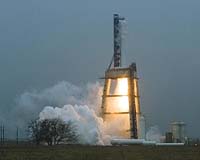
Hawthorne CA (SPX) Jan 29, 2008 On Jan. 18, Space Exploration Technologies (SpaceX) conducted the first multi-engine firing of its Falcon 9 medium to heavy lift rocket at its Texas Test Facility outside McGregor. The engines operated at full power, generating over 180,000 pounds of force, equivalent to a Boeing 777 at full power, and consuming 700 lbs per second of fuel and liquid oxygen during the run. "This is a major hardware milestone for our company," said Elon Musk, CEO and CTO of SpaceX. "It marks the first time that we have simultaneously fired two engines on the same stage. No significant problems were encountered transitioning from single-engine testing in November, which suggests that we will be able to ramp up rapidly to a full complement of nine Merlin engines. Our propulsion and test team has done a remarkable job." This two-engine test was the largest to date on the BFTS (Big Falcon Test Stand). The next run, scheduled for February, will use three engines operating for a full first stage mission duty cycle of three minutes. When operating in flight, the first stage will accelerate the 180-ft-long Falcon 9 vehicle to more than ten times the speed of sound in that short period of time. Following stage separation, the Falcon 9 second stage continues accelerating the payload to a final change in velocity that may be in excess of Mach 30 for missions beyond low Earth orbit. The test series will continue with five, seven and finally the full complement of nine engines. With all engines firing, the Falcon 9 can generate over one million pounds of thrust in vacuum or four times the maximum thrust of a 747 aircraft. SpaceX has designed its Merlin engine for rapid mounting and change-out. A new engine can be installed in a period of hours, a feature that will provide significant operational efficiency and responsiveness on the launch pad. The Merlin 1C next-generation, liquid-fueled rocket booster engine is among the highest performing gas generator cycle kerosene engines ever built, exceeding the Boeing Delta II main engine, the Lockheed Atlas II main engine, and on par with the Saturn V F-1 engine. It is the first new American booster engine in a decade and only the second American booster engine since the Space Shuttle Main Engine was developed thirty years ago. Merlin 1C will power SpaceX's next Falcon 1 mission, scheduled to lift off in Spring 2008 from the Central Pacific. The first Falcon 9 is scheduled for delivery to the SpaceX launch site at Cape Canaveral (Complex 40) by the end of 2008. Community Email This Article Comment On This Article Related Links Rocket Science News at Space-Travel.Com
 Virgin's Branson presents new space ship
 New York (AFP) Jan 23, 2008
British tycoon Richard Branson unveiled Wednesday his newest spaceship and said that test flights for the vessel would begin this year. |
|
|

| The content herein, unless otherwise known to be public domain, are Copyright 1995-2007 - SpaceDaily.AFP and UPI Wire Stories are copyright Agence France-Presse and United Press International. ESA Portal Reports are copyright European Space Agency. All NASA sourced material is public domain. Additional copyrights may apply in whole or part to other bona fide parties. Advertising does not imply endorsement,agreement or approval of any opinions, statements or information provided by SpaceDaily on any Web page published or hosted by SpaceDaily. Privacy Statement |