|
 |
 |
 |
 |
 |
 |
 |
 |

 |
SOHO To Give Early Warning Of Radiation Storms
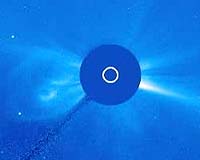
Greenbelt MD (SPX) Feb 28, 2008 Explosive events on the sun can blast particles to high speeds, causing intense radiation storms that can disable spacecraft and cause radiation sickness or cancer in unprotected astronauts. Advance warning of radiation storms could give astronauts time to take cover and allow satellite operators to take protective measures. Scientists are now testing a new method that could do just that. The method uses data from the Solar and Heliospheric Observatory (SOHO) to predict, in real-time, the approach and intensity of hazardous solar particles that would threaten astronauts and technology in space. The method was developed eight months ago by Dr. Arik Posner, of Southwest Research Institute (SwRI), San Antonio, Texas, with collaborators from the University of Kiel in Germany, NASA's Goddard Space Flight Center, Greenbelt, Md., and the University of Turku in Finland. It shows how the latest results from basic solar physics research can be used rapidly for operational applications, such as in space exploration. Posner used data from the Comprehensive Suprathermal and Energetic Particle Analyzer (COSTEP) on the SOHO satellite. "It provides advance warning up to about one hour," says Posner, who is stationed at NASA Headquarters, Washington, DC. "Although it seems relatively short notice, the warning can be mission-critical during extravehicular activities, such as on the lunar surface, but in most cases it will simply reduce astronauts' total exposure to radiation." "Expanding our capabilities for monitoring radiation outbursts from the sun is one of the critical issues that we must continue to address for human space exploration," says Dr. Stephen Guetersloh, member of the Space Radiation Analysis Group of NASA's Johnson Space Center in Houston. "This becomes even more crucial for Exploration class missions. The transition of scientific data into an operationally useful tool is an important and invaluable approach." Radiations storms begin when stressed solar magnetic fields snap to a new shape, like a rubber band that's been twisted too far. This can release as much energy as a billion one-megaton atomic bombs, and it accelerates solar particles to high speeds. The early warning is possible because the particles do not arrive at the same time. Two kinds of particles are hurled into space during solar storm events. First to arrive are electrons, which are lightweight subatomic particles. In everyday life, we harness their flow as electricity. Protons and other ions are also accelerated. These heavier subatomic particles are just atoms with some or all of their electrons removed. Because electrons are more than a thousand times lighter than ions, they move faster than ions -- almost at the speed of light -- and arrive first. The new forecasting method calculates the appearance and intensity of solar ion events by measuring these relativistic (near light-speed) electrons. Extreme solar events create the relativistic electrons, which have characteristics that can be exploited to predict the time and intensity of later arriving ions, predominantly protons with energies more harmful to humans. Energetic protons and heavier ions are among the main constituents of solar radiation storms, and exposure of the human body to such ionizing radiation elevates cancer risk. Heavy exposure to these particles can also result in acute radiation syndrome, with symptoms that include nausea, skin burns or disruption of central nervous system function. "Earth's magnetic field helps prevent exposure to solar particle events," says Posner, "but as space exploration leads humans out of this protective magnetic cocoon, towards the Moon and into outer space, this and other methods of space weather forecasting will become increasingly important." SOHO is a project of international cooperation between the European Space Agency and NASA. COSTEP is funded by the German Aerospace Agency (DLR). The instrument was developed and built at the University of Kiel (Germany) in collaboration with the Alcala University (Spain). Community Email This Article Comment On This Article Related Links NASA SOHO project page Solar Science News at SpaceDaily
 UC Riverside Space Scientist Receives Unusual Grant From The Department Of Energy
 Riverside CA (SPX) Jan 29, 2008
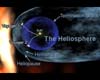
A UC Riverside research scientist has received an unusual grant from the Department of Energy. There is no dollar value to the grant. Instead, Nikolai V. Pogorelov has been awarded 850,000 processor hours on the seventh fastest computer in the world, located at Oak Ridge National Laboratory, Tenn. |
|
|

| The content herein, unless otherwise known to be public domain, are Copyright 1995-2007 - SpaceDaily.AFP and UPI Wire Stories are copyright Agence France-Presse and United Press International. ESA Portal Reports are copyright European Space Agency. All NASA sourced material is public domain. Additional copyrights may apply in whole or part to other bona fide parties. Advertising does not imply endorsement,agreement or approval of any opinions, statements or information provided by SpaceDaily on any Web page published or hosted by SpaceDaily. Privacy Statement |