|
 |
 |
 |
 |
 |
 |
 |
 |

 |
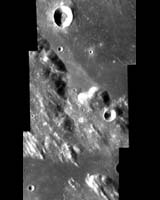
SMART-1 Views Sulpicius Gallus
Paris, France (SPX) Jul 19, 2006 This mosaic of three images, taken by the Advanced Moon Imaging Experiment on board ESA's SMART-1 spacecraft, shows the area close to the Sulpicius Gallus crater on the Moon. AMIE obtained this sequence on March 18, from a distance of 1,200 kilometers (744 miles) from the surface, with a ground resolution ranging from 110 meters to 114 meters (357 feet to 370 feet) per pixel. The area shown in the top image is centered at 19.7 degrees north lunar latitude and 12.2 degrees east longitude. The middle image is centered at 18.2 degrees north and 12.3 degrees east, and the bottom image is centered at 16.7 degrees north and 12.5 degrees east. Sulpicius Gallus is the prominent crater at the upper left. It is a fairly fresh, bowl-shaped crater with a diameter of roughly 12 kilometers (7.4 miles). The flat lava plains surrounding it belong to the Mare Serenitatis - the Sea of Serenity - on the northeastern side of the Moon facing Earth. The mountains going diagonally through the middle part of the mosaic are called Montes Haemus. They mark the edge of the huge impact crater that formed the Mare Serenitatis. Scientists consider the area around Sulpicius Crater very interesting, because it is one of the most geologically and compositionally complex areas of the near side of the Moon. The geologic history of this region has been shaped by impacts of different scales and epochs, by volcanism of variable style and composition with time, and by limited tectonics. Previous studies using ground-based images have detected relatively fresh highlands materials in the crater. Good spectroscopic data - relative to the mineralogical composition - are available both from NASA's Clementine mission and from ground-based observations, allowing scientists to begin to understand the Moon's geological evolution. The area has been suggested to contain mixtures of glassy and black beads generated when large impacts melted part of the lunar surface. However, computer models of similar material have not been able to match the composition revealed by the data. Color observations of the AMIE camera will help in further clarifying these issues. So, the combination of high spatial resolution imaging and high spectral resolution spectroscopy from datasets from SMART-1, Clementine and ground based telescopes will finally allow to better model mineral mixtures on the Moon. Sulpicius Gallus is named after a Roman general, statesman and orator, who was famous for having predicted an eclipse of the Moon on the night before the battle of Pydna, in 168 BC. In his later years, he devoted himself to the study of astronomy. Community Email This Article Comment On This Article Related Links SMART-1 Mars News and Information at MarsDaily.com Lunar Dreams and more
 British Geek Wants To Buy Moon Plot With 1M-Pound Gameshow Jackpot
 London, England (AFP) Jul 18, 2006
A self-confessed geeky housewife said she wanted to buy a plot on the Moon after winning a million pounds ($1.8 million, 1.5 million euros) on a British television game show Sunday. Sarah Lang, 31, from Newport, south Wales, scooped the prize in the finale of Pokerface, a game of general knowledge and bluff. |
|
|

| The content herein, unless otherwise known to be public domain, are Copyright 1995-2006 - SpaceDaily.AFP and UPI Wire Stories are copyright Agence France-Presse and United Press International. ESA PortalReports are copyright European Space Agency. All NASA sourced material is public domain. Additionalcopyrights may apply in whole or part to other bona fide parties. Advertising does not imply endorsement,agreement or approval of any opinions, statements or information provided by SpaceDaily on any Web page published or hosted by SpaceDaily. Privacy Statement |