|
 |
 |
 |
 |
 |
 |
 |
 |

 |
SMART-1 Tracks Crater Lichtenberg And Young Lunar Basalts
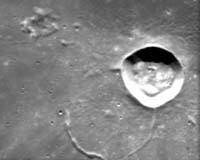
Washington DC (SPX) Feb 06, 2006 This image, taken by the Advanced Moon Imaging Experiment on board ESA's SMART-1 spacecraft, illustrates a special pointing mode, the so-called target-tracking mode. The image shows crater Lichtenberg in the Oceanus Procellarum region on the Moon, centered on an area located at 66.8 degrees west and 32.6 degrees north. The AMIE camera obtained the image from a distance of between 2,064 and 2,162 kilometers (1,320 and 1,384 miles) with a ground resolution of between approximately 186 and 195 meters (600 and 630 feet) per pixel. SMART-1 usually points straight down to the lunar surface using a mode called nadir-pointing, but the image was taken in a pointing mode called target-tracking. As the spacecraft moves around the Moon, it is commanded to keep pointing at the same target for a certain period of time, even though it moves over the lunar surface faster than 900 meters (2,925 feet) per second, or 3260 kilometers (2,085 miles) per hour. In this particular case, the distance between the target and the spacecraft changes by 100 kilometers (64 miles) every six minutes. The prominent crater in the lower right of the image is crater Lichtenberg, with a diameter of 20 kilometers (12.8 miles). The height difference between inner crater floor and surrounding lava plain is 1,300 meters (4,225 feet). The actual target of this observation was the ghost crater on the lower left of Lichtenberg. This is almost hidden by overflowed lava from Oceanus Procellarum. The SIR infrared spectrometer on board SMART-1 was measuring the composition of this area during these measurements. This area is of high geological interest and it was selected for the study of the most recent lunar volcanism. It is thought to contain the youngest basalts on the lunar surface, with an age of about 1 billion years. From geological mapping, scientists know that there are very young basalts around crater Lichtenberg, but how old are they really, and how long was lunar mare volcanism active? Recent data show lunar volcanism was active for at least 2 billion years beginning 4 billion years ago, and ceasing at about 2 billion years ago. In Oceanus Procellarum, it is thought that these basalts are the very youngest basalts on the lunar surface with an age of probably less than 1 billion years. This should be compared with the age of the Moon at about 4.5 billion years. Crater Lichtenberg is named after the German physicist Georg Christoph Lichtenberg (1742-1799), who was a professor at the University of Goettingen, Germany. Community Email This Article Comment On This Article Related Links Smart-1 Mars News and Information at MarsDaily.com Lunar Dreams and more
 Quantum Technique Can Foil Hackers
 Toronto ON (SPX) Feb 27, 2006
Canadian researchers said they have developed a technique that protect sensitive data transmitted via fiber-optic cables. Researchers at the University of Toronto developed the technique for governments and corporations in the business of transmitting sensitive data such as banking records or personal information, and they said it offers the protective equivalent of a fire-breathing dragon. |
|
|

| The content herein, unless otherwise known to be public domain, are Copyright 1995-2006 - SpaceDaily.AFP and UPI Wire Stories are copyright Agence France-Presse and United Press International. ESA PortalReports are copyright European Space Agency. All NASA sourced material is public domain. Additionalcopyrights may apply in whole or part to other bona fide parties. Advertising does not imply endorsement,agreement or approval of any opinions, statements or information provided by SpaceDaily on any Web page published or hosted by SpaceDaily. Privacy Statement |