|
 |
 |
 |
 |
 |
 |
 |
 |

 |
SMART-1 Maneuvers Prepare For Mission End
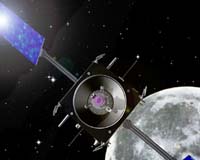
Darmstadt, Germany (SPX) Jun 26, 2006 After 16 months orbiting the Moon, ESA's lunar mission is preparing for the end of its scientific exploration. Last Monday, SMART-1 mission controllers initiated a 17-day series of maneuvers aimed at positioning the spacecraft to enhance science data return as the mission winds down. SMART-1, Europe's successful first Moon mission, is scheduled to end on Sept. 3, impacting on the lunar surface in a disposal plan similar to that of many earlier missions and almost three years to the day after its 2003 launch. With the maneuvers, ESA controllers aim to avoid having the spacecraft impact on the Moon at a disadvantageous time - from a scientific point of view - which would have happened on or about Aug. 17 if the spacecraft had been allowed to continue on its present trajectory. Instead, the extension of the mission will provide new opportunities for low-altitude scientific observations and optimum science returns during and after the spacecraft's controlled impact. In preparation for mission end, controllers at ESA's Spacecraft Operations Center have started a series of thruster firings to give a delta velocity, or change in velocity, of approximately 12 meters (39 feet) per second. This action will raise the orbit perilune (point of closest passage over the Moon) by about 90 kilometers (56 miles) and will shift the impact date to Sept. 3. "The shift in date, time and location for Moon intersection is also optimized to favor scientific observations from Earth," said Gerhard Schwehm, ESA's SMART-1 mission manager. "Projections based on the current orbit indicated that the spacecraft, if left as is, would impact the Moon on the far side, away from ground contact and visibility. The new location is on the Moon's near-side, at mid-southern latitudes," he added. For the maneuver campaign, the use of the electric propulsion system (the ion engine) had to be ruled out since all Xenon propellant reserves were exhausted during the mission. The mission control team instead has developed an imaginative approach. "The maneuver strategy consists of a series of reaction-wheel off-loadings combined with about three hours of intermittent thrust centered at apolune (point of furthest distance from the Moon) during the next 74 orbits," said Octavio Camino, Spacecraft Operations Manager at ESOC. The off-loading consists of braking a set of spinning wheels inside the spacecraft, which has the effect of transferring angular momentum from the wheels to the spacecraft and hence changing its velocity. "We use asymmetric firing of the attitude thrusters to produce a small velocity variation aligned with the flight direction. This will change the orbit by an accumulative effect," Camino said. "After these maneuvers, science activities will resume until the impact, with short interruptions for two trim maneuvers to adjust the impact time, one around the end of July and one at the beginning of September," he added. Community Email This Article Comment On This Article Related Links SMART-1 Mars News and Information at MarsDaily.com Lunar Dreams and more
 GMV To Provide Mission Planning Software For Lunar Reconnaissance Orbiter
 Rockville, MD (SPX) Jun 19, 2006
GMV Space Systems Inc., a satellite ground segment software company, announced Sunday that its FlexPlan software has been selected to provide the mission planning and scheduling system for NASA's Lunar Reconnaissance Orbiter spacecraft. |
|
|

| The content herein, unless otherwise known to be public domain, are Copyright 1995-2006 - SpaceDaily.AFP and UPI Wire Stories are copyright Agence France-Presse and United Press International. ESA PortalReports are copyright European Space Agency. All NASA sourced material is public domain. Additionalcopyrights may apply in whole or part to other bona fide parties. Advertising does not imply endorsement,agreement or approval of any opinions, statements or information provided by SpaceDaily on any Web page published or hosted by SpaceDaily. Privacy Statement |