|
 |
 |
 |
 |
 |
 |
 |
 |

 |
SMART-1 Impact Simulated In A Laboratory Sand-Box
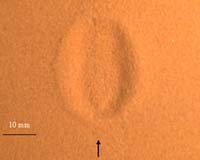
Paris, France (ESA) Sep 12, 2006 Laboratory simulations of the SMART-1 impact performed at the University of Kent, United Kingdom, suggest that the impact may have caused a clearly elongated lunar crater, and produced a high-speed rebounding for the spacecraft. This may help explain some properties of the dust cloud observed just after the actual impact of SMART-1 on the Moon. The simulations were performed by M.J. Burchell and M.J.Cole at the University of Kent. For the test, they used a high-speed, two-stage light gas gun to shoot at 2 kilometres per second a 2-millimitre aluminium sphere that simulated the SMART-1 spacecraft. The target was a tray of sand, similar to lunar soil. "We called for such laboratory simulations and numerical modelling of the SMART-1 impact as a crucial test to understand the processes at work in space-bound and artificial impacts," said Bernard Foing, ESA SMART-1 Project Scientist. Data from a previous project, in which Burchell and Cole made use of coarse grained sand, had shown that for an impact at a 10-degree incidence the fastest ejected material travelled forward (within about plus or minus 5 degree angle with respect to the impact direction) at 120 percent of the impact speed - a higher value than the impacting projectile had. However, at that 10-degree incidence angle only one percent of the material excavated by the impact went forwards and the percentage decreased as the angle got shallower. Out of that one percent, about 75 percent was at an angle to the surface greater than 10 degrees. "To reproduce the SMART-1 scenario we simulated an impact at two degrees incidence. The result was a nice non-circular crater," said Mark Burchell. "According to the test's results, the fine grained dust of the lunar surface was to raise a cloud of ejected material, which would have spread out sideways, as well as in a forward direction." Based solely on the results and ignoring scaling issues, Burchell and Cole predicted the size for the SMART-1 impact crater, expected to be 7 metres long and 4.5 metres wide. This was compatible with ESA's scaling-law predictions on the size of the SMART-1 crater. Burchell and Cole also observed a 'ricochet-projectile' phenomenon, suggesting a bounce like that of a single object that had undergone some deformation, with a slight 20 percent loss of speed during the impact. "Based on the latest topography analysis, SMART-1 touched down with a very grazing incidence not higher than a few degrees," said Foing. "Therefore it might have bounced in a similar way to the flying bullet in the sand box, like a stone skipping on water." "The result of these simulations may explain some of the properties of the clouds detected by the Canada-France-Hawaii telescope (CFHT) up to 100 seconds after the flash," added Pascale Ehrenfreund, coordinator of the SMART-1 impact ground-based observation campaign. "These were spread at some tens of kilometres downstream from impact," she concluded. Community Email This Article Comment On This Article Related Links SMART-1 Lunar Dreams and more Mars News and Information at MarsDaily.com Lunar Dreams and more
 Russia And China Could Sign Moon Exploration Pact In 2006
 Moscow (RIAN) Sep 12, 2006
Russia and China may conclude a Moon exploration agreement by the end of the year, the head of the Russian Space Agency said. China has already successfully launched into orbit two manned space vehicles. Its first manned flight three years ago made it the third country to launch a human being into space on its own, after Russia and the U.S. |
|
|

| The content herein, unless otherwise known to be public domain, are Copyright 1995-2006 - SpaceDaily.AFP and UPI Wire Stories are copyright Agence France-Presse and United Press International. ESA PortalReports are copyright European Space Agency. All NASA sourced material is public domain. Additionalcopyrights may apply in whole or part to other bona fide parties. Advertising does not imply endorsement,agreement or approval of any opinions, statements or information provided by SpaceDaily on any Web page published or hosted by SpaceDaily. Privacy Statement |