|
 |
 |
 |
 |
 |
 |
 |
 |

 |
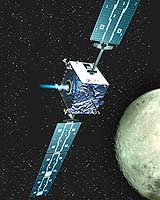
SMART-1's Electric Propulsion Is Functioning Perfectly
Paris (ESA) Oct 07, 2003 After more than 32 hours of accumulated thrust, the SMART-1 electric propulsion system (EPS), with a SNECMA PPS-1350-G Hall-Effect thruster, is now fully tuned for nominal operations under space conditions. The thruster performance and discharge stability are very good and confirmed by the measurements of total spacecraft acceleration over an orbit. As planned, the EPS commissioning had started during the fourth orbit with a venting sequence of the xenon subsystem in order to eliminate any presence of water vapour and oxygen. Then a first firing sequence of 50 minutes was completed successfully with the nominal cathode followed by a 6 minutes sequence at full power on the redundant one. This sequence was interrupted by discharge flame out after the thruster had remained in a high oscillation mode. After a complete electrical check of the system, the thruster was fired successfully on the primary cathode for 2.5 hours.
The ion drive Finally, with the help of the EPDP (Laben, Italy) and SPEDE (FMI, Finland) payload instruments, a lot of new information to be further processed and analysed is being acquired on the possible effects of the space environment on some typical EPS characteristics as experienced during ground testing. The SMART-1 mission plays perfectly its role of technology demonstration mission in the space environment and will strongly contribute to the acceptance of electric propulsion as a fully mature and flight-proven technology. Editor's Note: During the transfer phase of the Smart-1 mission to the moon, SpaceDaily will closely track the technical issues relating to the Ion propulsion system. These will be listed at ion-03...html Once at the moon the file name for this mission story will revert back to lunar-03...html. Community Email This Article Comment On This Article Related Links SpaceDaily Search SpaceDaily Subscribe To SpaceDaily Express Space Technology News - Applications and Research
 Industry Team Achieve New Communications Technology With AESA Radars
 Baltimore MD (SPX) Jan 12, 2006
A team comprised of three leading US aerospace and defense contractors has demonstrated an innovative technological use of active electronically scanned array (AESA) radars for high-bandwidth communications. |
|
|

| The content herein, unless otherwise known to be public domain, are Copyright 1995-2006 - SpaceDaily.AFP and UPI Wire Stories are copyright Agence France-Presse and United Press International. ESA PortalReports are copyright European Space Agency. All NASA sourced material is public domain. Additionalcopyrights may apply in whole or part to other bona fide parties. Advertising does not imply endorsement,agreement or approval of any opinions, statements or information provided by SpaceDaily on any Web page published or hosted by SpaceDaily. Privacy Statement |