|
 |
 |
 |
 |
 |
 |
 |
 |

 |
SMART-1 Set For Payload Commissioning
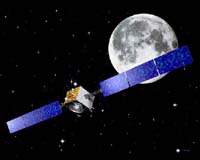
Paris - Jan 19, 2004 The spacecraft is now in its 187th orbit, in good status and with all functions performing nominally. In order to fine tune the altitude of the apogee point, required to minimise the length of the eclipses due to occur in March, the ion drive is currently being used only when the spacecraft is around perigee. This strategy will last until the end of January. Starting from early February the ion engine will not be used to generate thrust for a period of three weeks. This phase of the mission will be used to perform the scientific instrument commissioning. A series of observations of celestial targets with different instruments is being prepared and will be described in a future report. Another milestone was reached this week: the mission commissioning results review was held at ESOC. This review was planned to be held as soon as the first mission phase, the exit of the radiation belts, was completed. The results of the on-orbit verification of all the spacecraft subsystems were presented. All the subsystems have now been verified. However, some spacecraft functions have yet to be tested. This is because some are triggered by a failure scenario and others have not yet been needed. A plan has been prepared to solve the few anomalies that are still affecting the spacecraft's smooth operations. These include a software function to autonomously re-start the electric propulsion engine after an unexpected shutdown, a proper strategy to improve the performance of the star tracker that is affected by the combined effects of high temperature and radiation induced degradation, and a proper strategy to circumvent the occasional failures of the telemetry Reed-Solomon coding checksum. Community Email This Article Comment On This Article Related Links SpaceDaily Search SpaceDaily Subscribe To SpaceDaily Express Mars News and Information at MarsDaily.com Lunar Dreams and more
 SMART 1 Uses New Imaging Technique In Lunar Orbit
 Paris, France (ESA) Dec 28, 2005
ESA's SMART-1 spacecraft has been surveying the Moon's surface in visible and near-infrared light using a new technique, never before tried in lunar orbit. |
|
|

| The content herein, unless otherwise known to be public domain, are Copyright 1995-2006 - SpaceDaily.AFP and UPI Wire Stories are copyright Agence France-Presse and United Press International. ESA PortalReports are copyright European Space Agency. All NASA sourced material is public domain. Additionalcopyrights may apply in whole or part to other bona fide parties. Advertising does not imply endorsement,agreement or approval of any opinions, statements or information provided by SpaceDaily on any Web page published or hosted by SpaceDaily. Privacy Statement |