|
 |
 |
 |
 |
 |
 |
 |
 |

 |
SMART-1 Keeps On Thrusting With Solar Heated Gas
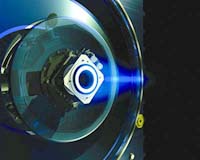
Paris - Dec 01, 2003 The spacecraft is now in its 120th orbit and has continued to function very well. As in previous weeks, the spacecraft was operated in electric propulsion mode almost continuously - only interupted during eclipse periods. From the beginning of this week, however, eclipse periods are no longer experienced and we can now maintain constant thrust. Although we have substantially increased the perigee SMART-1 is still crossing the radiation belts. It has been decided, therefore, to keep the no-thrust limit of 10 000 km to avoid possible problems caused by the ongoing high radiation environment. As a matter of fact, the solar activity is still quite high: two energetic solar flares on 18 November produced a cloud of ionised gas that impacted Earth on 20 November producing a severe geomagnetic storm that lasted for about twenty-four hours. Despite this environment, however, SMART-1 has managed to pass through unharmed. The total cumulated thrust time is now more than 760 hours and we have consumed about 12.5 kg of Xenon fuel. The electric propulsion engine performance, periodically monitored by means of the telemetry data transmitted by the spacecraft and by radio-tracking by the ground stations, has shown in the last period a slight reduction with respect to previous over performance in thrust and is now at about +1.3%. This is due to early adjustments to the working conditions of the engine. In this period a series of tests were performed on the engine with excellent results. The redundant cathode B has been commissioned and proved to be functioning very well. Its performance was identical to the operational cathode A, which has been functioning for more than 700 hours and shows no degradation. A new procedure to immediate ignite at full thrust has also been validated. We have made ground tests to establish the cause of the earlier flame-out events. The cause of the problem has been identified in an electronic component which, under the effect of a single event upset caused by radiation, erroneously sets the voltage reference to zero - hence triggering the flame-out detection. We have now prepared a procedure to automatically detect these events and restart the engine autonomously. The electrical power produced by the solar arrays continues to be affected, as expected, by the radiation environment. We are now analysing, in more detail, this behaviour by taking into account the fact that the solar irradiance is slightly higher now, due to Earth perihelion on 3 January, compared with launch. According to the latest SOHO measurement there has been an increase in the solar constant by about 2.7% over this period. The solar arrays have reduced their power output, due to radiation degradation, by about 82 W from the initial 1850 W (a fall of ~4.6%).
This degradation should last until the trajectory crosses the radiation belts, roughly mid-to-end of December. At this rate the solar arrays will have lost about 130 W at the exit of the radiation belts; after that the degradation should be minor. Due to the built in power margins this will allow the spacecraft to continue thrusting at full power and shorten the time envisaged to reach the Moon. A more detailed analysis on the power degradation is currently being performed and more results will follow shortly. Stay tuned. The communication, data handling and on-board software subsystems have been performing very well in this period. The thermal subsystem also continues to perform well and all temperatures are as expected. The only item still of concern is the optical head temperature on one of the star tracker's, which is too high (~17 �C) during parts of the orbit. The momentary loss of attitude determinations has been, as previously, up to 300 times per day for an average time of only one second. There are no negative consequences arising from this problem. There is another star tracker, which provides good attitude determination, and the system is anyway capable of coping with much longer periods without both star trackers. The thermal engineers have now envisaged ways of partially reducing the temperature of the star tracker optical heads. More on this in the next report. Community Email This Article Comment On This Article Related Links Smart-1 Mission Home SpaceDaily Search SpaceDaily Subscribe To SpaceDaily Express Mars News and Information at MarsDaily.com Lunar Dreams and more
 SMART 1 Uses New Imaging Technique In Lunar Orbit
 Paris, France (ESA) Dec 28, 2005
ESA's SMART-1 spacecraft has been surveying the Moon's surface in visible and near-infrared light using a new technique, never before tried in lunar orbit. |
|
|

| The content herein, unless otherwise known to be public domain, are Copyright 1995-2006 - SpaceDaily.AFP and UPI Wire Stories are copyright Agence France-Presse and United Press International. ESA PortalReports are copyright European Space Agency. All NASA sourced material is public domain. Additionalcopyrights may apply in whole or part to other bona fide parties. Advertising does not imply endorsement,agreement or approval of any opinions, statements or information provided by SpaceDaily on any Web page published or hosted by SpaceDaily. Privacy Statement |