|
 |
 |
 |
 |
 |
 |
 |
 |

 |
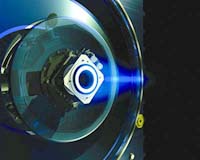
SMART-1 Ion Drive Restarted
Paris, France (ESA) Aug 26, 2005 After 5 months of Electric Propulsion pause, SMART-1's ion engine was nominally restarted as planned on 2 August. The EP power is being set to 1325W due to the Sun distance seasonal effect. The critical point of 1.8 Kg of Xenon will be achieved during the first week of September when special procedures will be implemented. The tests done with the simulator have predicted a transition to under-regulated thrust at a remaining xenon level of 0.73 to 0.78 kg (depending upon temperature). The EP operations are planned to last until mid September assuming simulator behaviour. The second half of September has been reserved for possible special operations in case the engine does not behave as expected.
Future Activities
Spacecraft Status The re-boost phase has started during the reporting period. EP, Power and Thermal subsystems were working well. Due to the season effect, the re-boost phase started close to the maximum spacecraft to Sun distance, it means, close to the point of lower solar array power generation. EP activities have re-started on 2 August. The Flight Dynamic strategy consists in 2 pulses per orbit of 68 minutes each. During this period, the FlameOut Monitoring is only enabled approximately half of the pulse duration. It is switched on just 3 minutes after the expected regular thrust event and it is disabled 35 minutes before the expected end of the pulse. The reason of that is to avoid an automatic recovery action that could be executed after the power off commanded by Flight Dynamic. The following plots correspond to the called Re-boost Phase Week 1: 2 Aug 10:000 � 5 Aug 12:00:00.
Email This Article Comment On This Article Related Links SpaceDaily Search SpaceDaily Subscribe To SpaceDaily Express Mars News and Information at MarsDaily.com Lunar Dreams and more
 SMART 1 Uses New Imaging Technique In Lunar Orbit
 Paris, France (ESA) Dec 28, 2005
ESA's SMART-1 spacecraft has been surveying the Moon's surface in visible and near-infrared light using a new technique, never before tried in lunar orbit. |
|
|

| The content herein, unless otherwise known to be public domain, are Copyright 1995-2006 - SpaceDaily.AFP and UPI Wire Stories are copyright Agence France-Presse and United Press International. ESA PortalReports are copyright European Space Agency. All NASA sourced material is public domain. Additionalcopyrights may apply in whole or part to other bona fide parties. Advertising does not imply endorsement,agreement or approval of any opinions, statements or information provided by SpaceDaily on any Web page published or hosted by SpaceDaily. Privacy Statement |