|
 |
 |
 |
 |
 |
 |
 |
 |

 |
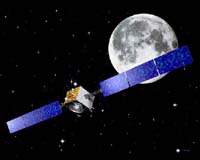
SMART-1 Finally Escapes the Radiation Belts
Paris (ESA) Jan 07, 2004 The spacecraft is now in its 176th orbit, in good status and with all functions performing nominally. The first mission target, namely to exit the most dangerous part of the radiation belts, has been achieved! The pericentre altitude (the closest distance of the spacecraft from the centre of the Earth) will reach the prelaunch target of 20 000 km on 7 January 2004. Between 23 December 2003 and 2 January 2004, the thruster fired continuously for a record duration of more than 240 hours. This is likely to remain the record for some time because later this week SMART-1 will change from a continuous thrust strategy to a more orbitally efficient thrust arcing. The total cumulated thrust so far of more than 1500 hours, consuming 24 kg of Xenon, has provided a velocity increment of about 1070 ms-1 (equivalent to 3850 km per hour). The electric propulsion engine's performance, periodically monitored by means of the telemetry data transmitted by the spacecraft and by radio-tracking by the ground stations, continues to show a small over performance in thrust: varying from 1.1% to 1.5% over the last week. The degradation of the electrical power produced by the solar arrays has now ceased. The power available has remained virtually constant since November 2003. The communication, data handling, on-board software and thermal subsystems have been performing well in this period. From the start the electric propulsion system has managed to increase the semi-major axis of the orbit by 13 179 km and increasing the perigee altitude from the original 656 km to 12 801 km. The orbital period has almost been doubled from the initial 10 hours 41 minutes to the present 20 hours and 19 minutes. Community Email This Article Comment On This Article Related Links Smart-1 Mission Site SpaceDaily Search SpaceDaily Subscribe To SpaceDaily Express Mars News and Information at MarsDaily.com Lunar Dreams and more
 SMART 1 Uses New Imaging Technique In Lunar Orbit
 Paris, France (ESA) Dec 28, 2005
ESA's SMART-1 spacecraft has been surveying the Moon's surface in visible and near-infrared light using a new technique, never before tried in lunar orbit. |
|
|

| The content herein, unless otherwise known to be public domain, are Copyright 1995-2006 - SpaceDaily.AFP and UPI Wire Stories are copyright Agence France-Presse and United Press International. ESA PortalReports are copyright European Space Agency. All NASA sourced material is public domain. Additionalcopyrights may apply in whole or part to other bona fide parties. Advertising does not imply endorsement,agreement or approval of any opinions, statements or information provided by SpaceDaily on any Web page published or hosted by SpaceDaily. Privacy Statement |