|
 |
 |
 |
 |
 |
 |
 |
 |

 |
SES Negotiating To Sell AMC-14 To US Government Agency
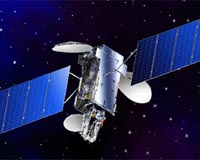
Gerroa, Australia (SPX) Apr 23, 2008 The fate of geo stationary satellite AMC-14 that failed to achieve its desired orbit in March continues to cause problems for the Luxembourg-based SES group and its underwriters. SpaceDaily has learned that SES has backtracked on their original plan to ditch the Lockheed Martin built A2100 satellite, and is trying to offload the spacecraft to a US government agency before an SES competitor or even one of its own customers buys it from the underwriters. Sources have told SpaceDaily that a US Department of Defense agency is negotiating to buy the AMC-14 satellite from SES directly with a loss adjustment then to be paid out by the underwriters. The US government would then move AMC-14 to a geostationary orbit inclined at roughly 10 degrees to the equator. Sources warned "the government is being had. SES is selling them an inferior mission. SES is purposefully downplaying the other options to protect themselves." As reported earlier in SpaceDaily SES is reluctant to pursue a rescue that uses a Lunar flyby due to a legal dispute with Boeing involving several issues including a patent that lays claim to the lunar flyby process. At the same time, there are other issues with such a purchase. A government purchase and use of this spacecraft may be a violation of the Commercial Space Act of 1998, which prohibits US government agencies from owning spacecraft to produce products they can buy commercially. "Any capability available on AMC-14 can be purchased commercially. If the government needs this sort of service, they must buy it from commercial providers as the 1998 Commercial Space Act requires." an industry expert requesting anonymity told SpaceDaily. Meanwhile, the lunar flyby rescue option continues to be dismissed by SES to their potential government customer and to the underwriters. "The last thing they want is for that option to be proven out. They told the underwriters that only an inclined orbital profile was available. It would look bad if someone were to salvage the spacecraft and perform the lunar transfer mission." While the underwriters may have been misled, they are more worried about offending SES than they are about paying out. SES is the biggest player in the GEO market and an endless source of rich insurance premiums. Further complicating the situation is the entry of several other commercial entities that are negotiating with the underwriters to buy the satellite and then use the lunar flyby process to recover the satellite into GEO. Despite claims by SES that "the numbers didn't work" for even a two to three year mission lifetime, experts have mapped out a mission profile similar to the 1998 HGS-1 trajectory that produces more than five years of operational lifetime in a GEO orbit. Of critical concern for SES at this stage is preventing negotiations between the underwriters and these other entities from coming to fruition. SES would like to both get the payoff from the underwriters and to prevent the spacecraft from ending up in the hands of competitors. "They would specifically like to prevent the vehicle from being bought by Echostar, the customer that originally intended to lease AMC-14 from SES," sources told SpaceDaily. Echostar announced in March the creation of a separate business unit that would compete with SES for fixed satellite services. Community Email This Article Comment On This Article Related Links SES The latest information about the Commercial Satellite Industry
 RRsat Increases Its North American Customer Service Through Intelsat's Galaxy Fleet
 Pembroke, Bermuda (SPX) Apr 22, 2008
Intelsat has announced that RRsat Global Communications Network has signed a multi-year contract on Intelsat's Galaxy 25 satellite to expand RRsat's services into the North American region. RRsat contracted for capacity on Intelsat's Galaxy 25 satellite for content broadcasting throughout North America. |
|
|

| The content herein, unless otherwise known to be public domain, are Copyright 1995-2007 - SpaceDaily.AFP and UPI Wire Stories are copyright Agence France-Presse and United Press International. ESA Portal Reports are copyright European Space Agency. All NASA sourced material is public domain. Additional copyrights may apply in whole or part to other bona fide parties. Advertising does not imply endorsement,agreement or approval of any opinions, statements or information provided by SpaceDaily on any Web page published or hosted by SpaceDaily. Privacy Statement |