|
 |
 |
 |
 |
 |
 |
 |
 |

 |
SES Astra Awards Astra 1M Contract To EADS Astrium
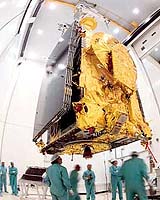
Toulouse, France (SPX) Jul 21, 2005 SES Astra, an SES Global company (Euronext Paris and Luxembourg Stock Exchange: SESG) is pleased to announce that it has awarded the contract for the construction of its ASTRA 1M satellite to European manufacturer EADS Astrium. EADS Astrium, as prime contractor for ASTRA 1M, will design and build the satellite and supply both the payload and the platform. European industry will supply the majority of the spacecraft equipment and technology. The satellite will provide a full range of television broadcasting services, including HDTV and other advanced audiovisual as well as broadband services. The ASTRA 1M spacecraft will provide eventual replacement capacity at 19. 2 East and will support and protect SES Astra's growth at the 28.2 East orbital position serving the UK and Irish markets. This growth is secured through ASTRA 1M protecting the timely relocation of ASTRA 2C to 28. 2 East from its current position at 19.2 East, such relocation being nominally planned after the successful launches of ASTRA 1KR and ASTRA 1L. This strategy provides additional capacity to meet the strong demand in the UK and Irish markets, driven by the expected growth of HDTV services. This optimised fleet configuration will also release an additional 8 transponders for the African market. EADS Astrium will manufacture the ASTRA 1M spacecraft based on its flight-proven and state-of-the-art Eurostar E3000 platform, the latest version of the Eurostar series, which first became part of the SES fleet with the ASTRA 2B spacecraft launched in September 2000. ASTRA 1M will carry 36 transponders for the first five years (32 thereafter) covering the FSS and BSS frequency bands. The spacecraft will feature pan-European coverage. 150 Watt TWTA's (Travelling Wave Tube Amplifiers) will provide optimal output for reception on small sized dishes throughout the coverage area. The satellite will be specified for a minimum service life of 15 years. It will have a launch mass of 5300 kilograms, a solar array span of 35 metres once deployed in orbit, and spacecraft power of 10 kW at end of life. The ASTRA 1M spacecraft will be compatible with all flight proven launch vehicles. SES Astra will choose a launch service provider in the near future. "We are most pleeased to work with EADS Astrium on the ASTRA 1M mission, and building on our fruitful cooperation on ASTRA 2B", said Ferdinand Kayser, President and CEO of SES Astra. "Our decision is proof of the competitiveness of the European Space industry in general, and EADS Astrium in particular." Antoine Bouvier, CEO of EADS Astrium, said: "We are delighted that SES Astra orders again an EADS Astrium satellite. Their decision to select us with an E3000 satellite confirms their confidence in the superior reliability of Eurostar and our industrial capability. We are convinced that this contract heralds a new phase of cooperation with SES Astra, who is a world leading operator and is recognized globally for its technical expertise." Community Email This Article Comment On This Article Related Links SES Astra EADS Astrium SpaceDaily Search SpaceDaily Subscribe To SpaceDaily Express The latest information about the Commercial Satellite Industry
 Stratos Steps Closer To Xantic Acquisition
 Bethesda MD (SPX) Jan 5, 2006
Stratos Global recently announced it had taken a step closer toward the completion of the acquisition of Xantic, having received positive advice from the Works' Council in the Netherlands, and executed a definitive agreement to purchase Xantic from KPN and Telstra Corporation. |
|
|

| The content herein, unless otherwise known to be public domain, are Copyright 1995-2006 - SpaceDaily.AFP and UPI Wire Stories are copyright Agence France-Presse and United Press International. ESA PortalReports are copyright European Space Agency. All NASA sourced material is public domain. Additionalcopyrights may apply in whole or part to other bona fide parties. Advertising does not imply endorsement,agreement or approval of any opinions, statements or information provided by SpaceDaily on any Web page published or hosted by SpaceDaily. Privacy Statement |