
 |
 |
 |
 |
 |
 |
 |
 |
 |

 |
SEPA Issues Challenge For Massive Solar Deployment
Washington DC (SPX) Oct 17, 2008 The Solar Electric Power Association (SEPA) has issued a challenge to the U.S. electric utility and solar industries to work in collaboration to meet aggressive solar electric capacity growth forecasts despite a struggling global and domestic economy. Prior to the recent economic downturn, analysts were predicting that the country could see an increase in solar capacity of more than thirty fold between 2009 and 2016. This is approximately three times the estimated amount of generation predicted to come on line as a result of existing renewable portfolio standards and policies in states with solar carve outs. If realized, this level of increased solar deployment would represent more than 60 billion kilowatt-hours of solar generation, 440,000 permanent jobs, and over $230 billion in investments and associated economic development benefits. "With the United States' growing electricity consumption and the need for climate change solutions, the utility and solar industries must work together to find innovative win-win business scenarios that result in significant investments in solar power," said Julia Hamm, SEPA executive director. "In the years to come, we need an economically-driven solar business environment in which utilities, solar companies, and electricity consumers find mutual financial benefits from the capacity, energy, and environmental solutions offered by solar electricity." Long-term U.S. market stability-provided by the eight year extension of the federal solar investment tax credit, removal of the $2,000 cap on residential systems, and new eligibility for electric utilities-sets the stage for this significant challenge to be met. "The current suite of solar policies, including net metering, renewable portfolio standards, and piecemeal state incentives, will not be enough to achieve this goal in today's poor economy. We also need new business models, project configurations, and collaborations to emerge," added Hamm. "The long-term value to the United States is multi-faceted. It's not just about clean energy, but also about economic development and job creation." The new solar electric capacity will come from a combination of large-scale power plants, including photovoltaics, concentrating solar thermal electric, and distributed photovoltaic rooftop systems for both the residential and commercial sectors. Prior to 2008, the predominant solar market was distributed PV systems on homes and businesses. "A recent SEPA study shows that 10 utilities in the U.S. have integrated ninety seven percent of all grid connected solar capacity," said Hamm. "There are over 3,300 electric utilities in this country, but 10 of them have dominated the solar landscape. In addition, a single utility, Pacific Gas and Electric Company (PG&E) in California, has within its service territory, more than fifty percent of all grid-connected PV systems in the country. PG&E should be commended and encouraged to continue as a solar leader, but other utilities around the country must quickly begin to close this gap." To meet the aggressive solar capacity growth forecasts, SEPA calls for: Utility ownership of solar power projects. The utility and solar industries must collaborate to find program structures, such as utility ownership of distributed photovoltaics, that provide a winning scenario for both industries, as well as for customers at large. The solar industry can utilize this new market segment as a buffer until home and small business owners are back on more solid economic footing. Increased utility engagement in solar markets. The utility and solar industries must work together to get more utilities engaged, starting by increasing the solar knowledge base of utility employees, from top executives down to distribution engineers. We must move beyond having ninety seven percent of all grid-connected solar installations in just 10 utilities' service territories. Greased wheels. The utility and solar industries must work in partnership with regulators and investors to push for approval and funding of new transmission projects and the development of smart grid configurations to expedite the timeframe in which new utility-scale and distributed solar projects can come on line and provide maximum value. Development of innovative approaches. By working in collaboration, the utility and solar industries can make great strides towards modernizing today's electricity infrastructure and offering customers affordable and clean power. But the status quo will not achieve the necessary results. We need bold new ideas developed in tandem for the mutual benefit of both industries, and society at large. Community Email This Article Comment On This Article Share This Article With Planet Earth
Related Links Solar Electric Power Association All About Solar Energy at SolarDaily.com
 Sharp Introduce Second Generation Thin Film Solar Cells
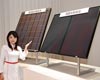 San Diego CA (SPX) Oct 17, 2008
 Sharp has announced at Solar Power International 2008 that it will introduce next generation thin film solar cells in the U.S. market in the near future. |
|
|

| The content herein, unless otherwise known to be public domain, are Copyright 1995-2007 - SpaceDaily.AFP and UPI Wire Stories are copyright Agence France-Presse and United Press International. ESA Portal Reports are copyright European Space Agency. All NASA sourced material is public domain. Additional copyrights may apply in whole or part to other bona fide parties. Advertising does not imply endorsement,agreement or approval of any opinions, statements or information provided by SpaceDaily on any Web page published or hosted by SpaceDaily. Privacy Statement |
 del.icio.us
 Digg
Digg Reddit
 YahooMyWeb
 Google
 Facebook