|
 |
 |
 |
 |
 |
 |
 |
 |

 |
SDL Project Launches To Help Observe The Earth'S Ozone
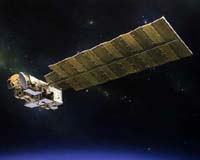
Logan UT (SPX) Jun 10, 2004 A critical piece of hardware built by the Space Dynamics Laboratory for the Tropospheric Emission Spectrometer (TES) instrument is launching into space on June 19 aboard NASA's Aura satellite to help scientists study the ozone. The TES interferometer, or sensor, will break light up into colors in order to measure chemicals that affect the ozone. This data will enable scientists to better understand the condition of the Earth's upper and lower atmosphere and will help them study global warming. "It was a difficult piece of hardware to build," Robert Anderson, SDL program manger for TES, said. "It's always a pleasure to see something I worked on go up in space." The SDL built hardware worth $3.1 million is called TES-FPOMA (Focal Plane Opto-Mechanical Assembly). It is the housing for TES's infrared interferometer sensor. The requirements for TES-FPOMA from NASA's Jet Propulsion Laboratory (JPL) were so difficult that SDL was the only company to bid on the project. "FPOMA was challenging because of its tight tolerance system, and building it for three temperature zones was just another tricky part to the project," Blake Crowther, a senior optical scientist at SDL, said. "It's built to withstand temperatures that other mechanisms on TES cannot." TES-FPOMA consists of FPOMA-1 and FPOMA-2; both are designed for separate spectral channels. It was completed and delivered in 2000, and since then SDL has been anxiously awaiting its launch. John Elwell, a senior engineer at SDL, said building TES-FPOMA was difficult because everything shrinks at different temperatures and they had to build around that. "It was a really fun project," he said. "We did everything we were asked without anything changing. We started it, built it, and delivered it, and everyone was happy." Anderson said TES-FPOMA was successful because the team put in a lot of hard work and long hours. The team, which averaged around 10 employees, put in over 80-hour weeks during the final stages of the project. "The project manager for JPL had nothing but positive things to say about our work," Elwell said. "He praised it." Aura is the third in a series of major Earth observing satellites to study the environment and climate change and is part of NASA's Earth Science Enterprise. There are three other instruments aboard NASA's Aura, including the High Resolution Dynamics Limb Sounder (HIRDLS), the Microwave Limb Sounder (MLS) and the Ozone Monitoring Instrument (OMI). These instruments along with TES will work together to provide measurements in the troposphere and stratosphere to help answer important climate questions. Aura will be launching on a Delta II rocket from Vandenberg, Calif., into a near polar, sun-synchronous orbit with a period of approximately 100 minutes. The launch window is set for 4:01 a.m. to 3:04 p.m. EST on June 19. Community Email This Article Comment On This Article Related Links SDLTES SpaceDaily Search SpaceDaily Subscribe To SpaceDaily Express Earth Observation News - Suppiliers, Technology and Application
 New Legislation Initiated To Support Commercial Remote Sensing Industry
 New York NY (SPX) Jan 11, 2006
The importance of remotely sensed data and technologies to support natural disasters has prompted attention and action in Washington. New initiatives and legislation authorizing appropriations to the remote sensing industry will be discussed at Strategic Research Institute's U.S. Commercial Remote Sensing Industry conference, scheduled for February 9-10, 2006 in Washington D.C. |
|
|

| The content herein, unless otherwise known to be public domain, are Copyright 1995-2006 - SpaceDaily.AFP and UPI Wire Stories are copyright Agence France-Presse and United Press International. ESA PortalReports are copyright European Space Agency. All NASA sourced material is public domain. Additionalcopyrights may apply in whole or part to other bona fide parties. Advertising does not imply endorsement,agreement or approval of any opinions, statements or information provided by SpaceDaily on any Web page published or hosted by SpaceDaily. Privacy Statement |