|
 |
 |
 |
 |
 |
 |
 |
 |

 |
SATNAV Industry Meet Held at ISRO Satellite Centre
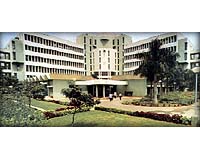
Bangalore, India (SPX) Jul 10, 2006 An ISRO-Industry Meet on Satellite Navigation was organised at the ISRO Satellite Centre, Bangalore, July 4, 2006. The meet, inaugurated by Mr G Madhavan Nair, Chairman, ISRO, covered topics on Indian Satellite Navigation programme, applications and opportunities, research, manufacturing and software development. Position, Navigation and Timing (PNT) is an important service available through the navigation satellites today. Small hand-held receivers are used to determine the user position anywhere in the world. Location based service will become as ubiquitous as a mobile phone very soon. Satellite based PNT service is of vital importance to economies and societies. It is emerging as an important space application area not only for civil aviation but in many other areas such as mobile telephones, surface transport, intelligent highway system, maritime transport, rail, oil and gas, precision agriculture, fisheries, survey and marine engineering, science, electricity networks and leisure. It is one of the main components of satellite based Communication, Navigation and Surveillance (CNS)/Air Traffic Management (ATM) system adopted by the International Civil Aviation Organisation (ICAO) for world-wide implementation. It will facilitate seamless navigation across geographical boundaries and would eventually replace different types of ground-based navigation systems providing services over different air spaces. The Department of Space (DOS) is the nodal agency for all matters connected with satellite navigation. ISRO/DOS has identified Satellite Navigation as an important thrust area and a large investment in this programme is slated for the 11th Five Year Plan. ISRO and AAI are implementing a satellite based navigation system over the Indian air-space for civil aviation called GAGAN, which consists of a space-segment and a ground segment. The space segment is a dual frequency (L1 & L5) GPS compatible payload on GSAT-4 under the Technology Demonstration System (TDS) Phase. The ground segment consisting of 8 Indian Reference Stations (INRESs), one Indian Master Control Centre (INMCC), one Indian Land Uplink Station (INLUS) and associated navigation software and communication links has been installed and a Preliminary System Acceptance Test (PSAT) has been just concluded. The position accuracies available are good. The Government has also approved a project recently to implement an Indian Regional Navigation system (IRNSS) over India in the next 5-6 years. It will consist of a constellation of 7 satellites and a large ground segment. The entire IRNSS system will be under Indian control. The space segment, ground segment and user receivers will be built in India. In this programme, which is extremely challenging technologically, India will take a major step towards providing an infrastructure for provision of PNT services through out India and the neighboring areas. The technological challenges include
- Satellites Through the Industry Meet held this month, DOS is taking steps to expose to the industry the opportunities available in this programme and to find meaningful business opportunities in the Indian scenario. The DOS is also forging international partnerships with other core constellation providers and academic institutions. A major investment by the Government should generate an equivalent or more investment by the industry and entrepreneurs in the years to come. ISRO/DOS is willing to look at funding critical technologies to enable industry to go hand in hand with ISRO. During the Industry Meet, Indian Satellite Navigation Programme was presented in detail by senior ISRO Engineers.
Core Constellations SATNAV Systems use two core constellations - Global Positioning System (GPS) of the United States and Global Navigation Satellite System (GLONASS) of the Russian Federation at present. Recently, Europe has announced that a 30-satellite constellation called Galileo is being developed and deployed jointly by EC and ESA. This system is planned to be operational by 2010.
Augmentations The positioning services offered by the GPS or GLONASS constellations for civil aviation fall short of the accuracy, integrity, availability and continuity of service requirements of air navigation services for landing. Augmentation systems have been developed to the core GPS constellation for enhancing the services provided by these core constellation to meet air navigation requirement for various phases of flight - from enroute to precision approach an landing. Satellite based Augmentation System (SBAS) is one form of augmentation system being developed as regional systems for large area coverage. Wide Area Augmentation System (WAAS) of USA, European Geo-stationary Navigation Overlay Systems (EGNOS) of Europe and MTSAT Satellite Augmentation System (MSAS) of Japan are the three emerging SBAS systems. These systems use navigation payloads on four Geo-stationary INMARSAT third generation satellites and the core GPS.
GPS System The US Defence planned GPS in the early 1970s.The GPS constellation consists of 28 satellites at present in the 20,000 km circular orbit. The GPS is being modernised through the addition of an L5 signal, modifications in the satellite and control segment to offer better accuracies and ruggedness. This is being done essentially to overcome the possibility of jamming GPS signals through low cost transmitters developed by many countries including Russia.
GLONASS System The Russian core constellation for satellite navigation called GLONASS was fully operational with 24 satellites in 1995. Then onwards, the number of satellites in the constellation has steadily declined to 8 now. The Russian Government is planning to increase the number of satellites in the constellation to a minimum of 21 by 2007 and 24 by 2008-09.
Galileo Europe decided to go ahead with an independent constellation of 30 satellites in the 24,000 km orbit called Galileo. The Galileo programme was approved by the EC council of Ministers on 26th March, 2002. The total estimated cost of Galileo is 3.2 billion Euros - 1.1 billion Euros for the validation and development and 2.1 billion Euros for the deployment phase. The operational cost of the Galileo system is estimated to be 220 million Euros annually. As on date, the EC and ESA own 50% share each of the investments made in the Galileo programme until 2005. Besides civil aviation, the Galileo system is aimed at providing service to various modes of transport, communications network, intelligent highway systems, personal mobility and vehicle tracking. Galileo Services Galileo system proposes to offer a host of services: an open service aimed at mass-market applications leading to low cost receivers, a safety of life service for most transport applications where lives could be endangered if the performance of the navigation system is degraded without real time notice, a commercial service aimed at market applications requiring higher performance than offered by the open service, a public regulated service aimed at groups such as police, fire, ambulance, military and customs, a search & rescue service as Europe's contribution to the cooperative effort on humanitarian search and rescue compatible with the COSPAS-SARSAT system. Community Email This Article Comment On This Article Related Links GPS Applications, Technology and Suppliers GPS Applications, Technology and Suppliers
 ESA Selects Esrange Space Center For Galileo Tracking
 Esrange, Sweden (SPX) Jul 14, 2006
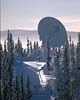
Swedish Space Corporation (SSC) has signed the ESA contract for providing a site for the northern TT and C antenna (Telemetry, Tracking and Command) at Esrange Space Center near Kiruna. The 13-meter antenna that will be located at Esrange is a key part of the global infrastructure needed to control the fleet of Galileo satellites. |
|
|

| The content herein, unless otherwise known to be public domain, are Copyright 1995-2006 - SpaceDaily.AFP and UPI Wire Stories are copyright Agence France-Presse and United Press International. ESA PortalReports are copyright European Space Agency. All NASA sourced material is public domain. Additionalcopyrights may apply in whole or part to other bona fide parties. Advertising does not imply endorsement,agreement or approval of any opinions, statements or information provided by SpaceDaily on any Web page published or hosted by SpaceDaily. Privacy Statement |