|
 |
 |
 |
 |
 |
 |
 |
 |

 |
SAFrica Fetes Chinese New Year With Dragons And Bollywood
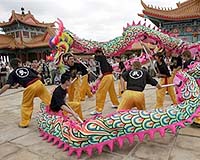
Bronkhorstspruit, South Africa, Jan 30 (AFP) Jan 30, 2006 Revellers at one of Africa's largest Chinese New Year festivities on Sunday paid tribute to South Africa's diversity in celebrations mixing the traditional lion dance with African music, a Bollywood song-and-dance routine and the flamenco. The eclectic programme, the first of its kind ever staged by the local Chinese community, was held in South Africa's largest Chinese temple in Bronkhorstspruit about 110 kilometres (70 miles) from Johannesburg. "This is a first. This year we included stuff from India, Spain and Africa to pay homage to South Africa's multi-cultural ethos. It was time we integrated," said Peter Just, a spokesman for the abbott of the Nan Hua temple. The festivities marking the start of the Year of the Dog began on Saturday night with a pyrotechnics display. On Sunday, the new year was ushered in in at the temple's giant courtyard with firecrackers to "ward off the evil spirits of the past year." Then came the traditional dragon and lion dances performed by agile young men, who swirled through the courtyard to the incessant beat of traditional drums while hundreds of white, black, Indian and Chinese participants cheered on. For Ni Men Fei, 53, a former resident of Shanghai, the festival was moving beyond words. "It reminds me of home. This temple is so grand that I am reminded of the Forbidden City," the seat of China's erstwhile Manchu rulers in Beijing, he said. "It is wonderful that we are celebrating our festival in Africa just like we do back home although there are more people taking part in China," he said. The abbott of the temple, Hui Fang, in his New Year message, exhorted the congregation to emulate the two main characteristics of a canine -- honesty and unquestioning friendship. "According to Chinese tradition, the dog symbolises honesty and friendship," he said. "It also is a symbol of obedience, understanding and peaceful co-existence." "I wish you all to practice loyalty," he added as an announcer listed eminent people born in the Year of the Dog ranging from former US president Bill Clinton to veteran Hollywood actress Shirley Maclaine and British primate expert Jane Goodall. A cultural show then followed, starting with displays of Chinese martial art forms such as kung fu and tai chi. The programme also included African dances and an Indian film song glorifying the Hindu god Krishnad followed by a flamenco routine by three castanet-wielding women. Becky Wei, who has lived in South Africa for 13 years and works at the Taiwanese liaison office here, said the Year of the Dog had a special place in Chinese hearts. "In Chinese, a dog's bark is called wong and it sounds like wong which is also the word for good luck," she said while using a slightly different intonation for the two words. "So all Chinese can be sure of peace and health and happiness," she said. The sprawling temple, meanwhile, became a gigantic open-air market where vendors sold a variety of goods: ranging from traditional rice cakes and Chinese savouries to Chinese clothes, bric-a-brac and joss sticks. Crowds thronged the 20-hectare (50-acre) complex to also gape at the immense pagoda-style temple with Chinese gazebos which houses an impressive museum. Anu Nepal, an Indian dancer who performed at the festival, said the experience was mind-blowing. "This is the first time I have performed at the Chinese New Year. The vibes were completely different as I reached out to a far wider audience than I would have at an Indian temple. There were Chinese, blacks and whites." "Twenty years ago, you would have never seen whites embracing other people's cultures. It was unthinkable. This change now just shows what a long way we have come in South Africa." South Africa's Chinese population is estimated between 100,000 and 200,000. Although small, they play a significant role in business.
Source: Agence France-Presse Community Email This Article Comment On This Article Related Links - China News from SinoDaily.com
 Clumsy Museum Visitor Breaks Three Qing Vases
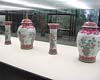 London, Jan 30 (AFP) Jan 30, 2006
A clumsy visitor to a Cambridge museum has destroyed a set of priceless 300-year-old Chinese vases after tripping up on his shoelace, the Daily Telegraph reported Monday. |
|
|

| The content herein, unless otherwise known to be public domain, are Copyright 1995-2006 - SpaceDaily.AFP and UPI Wire Stories are copyright Agence France-Presse and United Press International. ESA PortalReports are copyright European Space Agency. All NASA sourced material is public domain. Additionalcopyrights may apply in whole or part to other bona fide parties. Advertising does not imply endorsement,agreement or approval of any opinions, statements or information provided by SpaceDaily on any Web page published or hosted by SpaceDaily. Privacy Statement |