|
 |
 |
 |
 |
 |
 |
 |
 |

 |
Rwandan Pygmies Fight For Survival In Eco-Sensitive Times
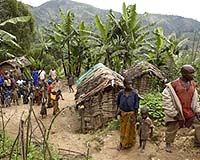
Bweyeye, Rwanda (AFP) May 10, 2006 In this remote corner of southern Rwanda, Twa pygmies are fighting a losing battle against the modern realities of environmentalism that are robbing them of their traditions. Sandwiched between the Burundian border and the edge of the dense Nyungwe rainforest, the village of Bweyeye is on the frontline of an increasingly divisive struggle between the diminutive Twa and the long arm of Rwandan law. Forced to abandon their centuries-old hunter-gatherer lifestyle by a ban on such activity in the maze of giant tropical trees, towering ferns and tiny orchids, many Twa have descended into crushing poverty and alcoholism. Nyungwe, home to chimpanzees and other monkey species, is a stretch of rainforest in this central African region and Rwandan officials are keen to exploit its eco-tourism potential by protecting it. But the Twa say the restrictions are destroying their community, which sits at the end of a track so potholed that even the most robust four-wheel drive vehicle struggles to do more than 10 kilometers (six miles) an hour. "I realize that nature reserves bring tourists and that tourists bring dollars, but we don't get to see any of those dollars here in Bweyeye," says Felicien Hakizimana, a 35-year-old Twa father of three. "This ban on setting foot in the forest is a problem because our ancestors lived from the forest, they even used to hunt elephants there," he said, adding that, once, the meat from an elephant could sustain a family for a month. "Now we will soon die of hunger," Hakizimana tells AFP. In addition to providing food, the vast 970-square-kilometer (375-square-mile) Nyungwe forest used to provide the Twa with essential fuel and raw materials such as wood for building. But no longer. While the forest ban is not new -- it was first imposed by the 1973-1994 regime of president Juvenal Habyarimana that ended with Rwanda's infamous genocide -- it is now being enforced with vigor, they say. "Sometimes we do sneak in, but it's very dangerous," says Manashe (eds: one name), a wizened barefoot Twa who looks far older than the 55 years he admits to being. The fine for those caught in the forest is between 10,000 and 15,000 Rwandan francs (18 to 27 dollars, 14 to 21 euros), an amount higher than the monthly income of most in Bweyeye that forces many offenders to opt for jail time instead. Evariste Munyemanzi is among those unable to pay the fine. The shoeless 36-year-old sits in detention at the Bweyeye police station. "We used to be potters, but you can't get the clay any more now," Munyemanzi complains. "It's tempting to go out and steal." The Twa insist that if and when they do go into the forest it is simply to collect firewood, but privately some admit to catching monkeys, baboons and forest rats. Bweyeye local administrator Octave Rukundo is well aware of the hardships the ban has caused but is adamant that the law be respected. "They say they go to get wood for fuel, but in fact they also take wood to sell," he told AFP. "They hunt the animals," Rukundo says. "They make traps, they dig holes two meters (six feet) deep and place branches over the top so that animals fall in. "They make fires to get smoke to chase bees away and collect their honey, but those fires can then burn the forest," he said, noting there had been two forest fires so far this year. "We have to find an activity to occupy them and to prevent them from going into the forest," Rukundo said, admitting this is easier said than done. Like other Rwandans, the Twa, who make up about one percent of the country's 8,000,000 population, used to own land, but as long as they had the forest it was of little importance and plots were sold off to their Hutu and Tutsi neighbors. It was only when the forest ban began to be enforced that they realized the importance of farming their own land and then it was too late. When the Twa here can get work it is usually on their neighbors' land and the pay is a pittance. "Sometimes I get work cleaning up my neighbor's plot," says Esperance Gashugi, a 50-year-old mother of five children who earns 200 francs (about 20 US cents, 16 euro cents) per day for the backbreaking labor. "I can buy sweet potatoes," she says. "There is never enough for all the children and they go to school on an empty stomach." In despair and frustration, some Twa have turned to drink. "The real problem," one non-Twa inhabitant of Bweyeye says, "is that these people don't want farmland, they don't want development projects." "What they want is to be able to go hunting in the forest again and that's not going to happen."
Source: Agence France-Presse Community Email This Article Comment On This Article Related Links - All About Human Beings and How We Got To Be Here
 Child Labor On Way Out
 United Nations (UPI) May 10, 2006
The U.N.'s International Labor Organization cited encouraging indications of an 11 percent reduction in child labor in the last four years, or a decrease of 28 million working children, especially in hazardous jobs. |
|
|

| The content herein, unless otherwise known to be public domain, are Copyright 1995-2006 - SpaceDaily.AFP and UPI Wire Stories are copyright Agence France-Presse and United Press International. ESA PortalReports are copyright European Space Agency. All NASA sourced material is public domain. Additionalcopyrights may apply in whole or part to other bona fide parties. Advertising does not imply endorsement,agreement or approval of any opinions, statements or information provided by SpaceDaily on any Web page published or hosted by SpaceDaily. Privacy Statement |