
 |
 |
 |
 |
 |
 |
 |
 |
 |

 |
Russian subs explore world's deepest lake
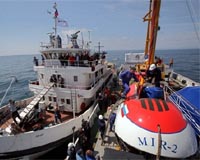
Lake Baikal, Russia (AFP) July 29, 2008 Two Russian mini-submarines on Tuesday dove to the bottom of the world's deepest lake to draw attention to its fragile environment but failed in a record-setting attempt, organisers said. Six crew members descended over 1,500 meters (4,900 feet) to the floor of Lake Baikal in Siberia in a bid to find new life-forms and encourage Russian authorities to take greater care of its pristine waters. But after an initial claim to have made the deepest freshwater dive in history, expedition members admitted they had miscalculated. "There was no record.... We'll try again," expedition leader Artur Chilingarov, a Russian parliamentarian and a celebrated Arctic explorer, said after the dive. "We want to study and observe Baikal, to preserve it," said Chilingarov, who led a submarine team last year that planted a Russian flag at the bottom of the North Pole. That dive aimed to stake a claim to the Arctic's rich energy reserves in a mission that was dismissed as a stunt by the United States. Like the Arctic dive, Tuesday's mission was extensively covered live on Russia's Vesti-24 television channel and hyped up further by Russian politicians. Expedition organisers said the mission signalled a revival of scientific discovery in Russia. The expedition also had a strong political dimension. Chilingarov said he had "full support" from Prime Minister Vladimir Putin and a flag for the ruling United Russia party could be seen flying from the expedition's barge. But crew members said the government needed to do more to protect the UNESCO-protected site. "Many people are concerned about the lake's fate, and not enough is being done," said Vyacheslav Nagovitsyn, head of the local Buryatiya region and one of the crew members. The scientists said they planned to collect samples at different depths and document the effects of global warming on the lake in the weeks to come, as well as study economic development in the region. Lake Baikal is the deepest lake in the world, although not the largest in terms of surface area. Environmental groups warn that increased pollution is threatening the lake, which has more than 800 unique wildlife species. On Tuesday, expedition organisers and a representative of Guinness World Records in Russia initially claimed that the Mir-1 mini-submarine had broken the record. But Chilingarov later admitted that the first of the submarines, Mir-1, went down only 1,580 metres (5,184 feet) and not 1,680 metres as initially calculated. The second vessel, Mir-2, went down further to 1,592 metres -- still not enough to set a record for the deepest submarine dive in fresh water. The current record of 1,637 metres was set in Lake Baikal in the 1990s. The Mir-1 and Mir-2 mini-submarines, which are each 7.8 metres (26 feet) long, have filmed the wreck of the Titanic and carried out work on the Kursk submarine, which sank in 2000 in the Barents Sea with 118 sailors on board. They were designed to descend to a depth of 6,000 metres. Community Email This Article Comment On This Article Share This Article With Planet Earth
Related Links Water News - Science, Technology and Politics
 Russian scientists head for bottom of the abyss
 Tourka, Russia (AFP) July 28, 2008
Russian scientists will on Tuesday attempt to reach the bottom of the world's deepest freshwater abyss in a bid to find unknown life forms as well as claim a new record. |
|
|

| The content herein, unless otherwise known to be public domain, are Copyright 1995-2007 - SpaceDaily.AFP and UPI Wire Stories are copyright Agence France-Presse and United Press International. ESA Portal Reports are copyright European Space Agency. All NASA sourced material is public domain. Additional copyrights may apply in whole or part to other bona fide parties. Advertising does not imply endorsement,agreement or approval of any opinions, statements or information provided by SpaceDaily on any Web page published or hosted by SpaceDaily. Privacy Statement |
 del.icio.us
 Digg
Digg Reddit
 YahooMyWeb
 Google
 Facebook