
 |
 |
 |
 |
 |
 |
 |
 |
 |

 |
Russian helicopter plans part two
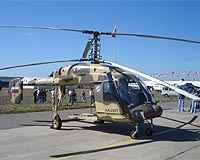
Moscow (UPI) Oct 14, 2008 Russian military operations against the former Soviet republic of Georgia in August have shown that communications and reconnaissance are the Russian army's weak spot. Therefore unmanned aerial vehicles should be rushed through the stages of development, pilot production and official approval. In the same vein, efforts will be stepped up to improve Russia's combat might in accordance with its new doctrine and to set up a rapid deployment force. The percentage of helicopters among the 200 to 300 pieces of equipment planned for paratroops and special forces will be high. And, of course, there will be a need for upgraded and advanced helicopters. Many remember Russia's tender to supply army helicopters to Turkey, a saga that lasted several years. The Turks moved the goalposts three times. But the Russians always accepted the new conditions -- and won in the end. However, no contract was concluded because of pressure from overseas. But Russian designers left the tender stronger and more confident. And now they are being showered with orders to upgrade helicopters for the navy and supply new ones to other countries. Different versions of the Kamov Ka-32 helicopter successfully operate in Canada, Korea, Chile, Mexico, Spain, Portugal, Japan and China. Contracts have been signed to supply Mil Mi-24NPs to the Russian air force and Mil Mi-35Ms to Venezuela. Work is under way on secret projects for security agencies. Helicopters in Russia are a must, as they provide transport services where there are no roads or waterways. According to the Industry and Trade Ministry, Russia has fewer than 14 civilian helicopters per 1 million of population, while in Canada the figure is 56; in the United States, 40; and in Japan, 15. Russia badly needs light helicopters. The Kamov Ka-226 is a multifunction three-tonner, its blades are made of composite polymer materials and it can carry either 10 rescuers or two wounded together with medical attendants, and 1.5 tons of suspended cargo to a distance of 360 miles. The Mil Mi-34 is just a tiny tot. Will they be able to compete with foreign imports? The crux of the matter is on-board avionics, new technologies, and access to world standards. But given cooperation -- either with Agusta, Eurocopter, or Pratt & Whitney -- there is every sense not to preach screwdriver technology -- something Russia's auto industry indulges in -- but to obtain licenses for key know-how at once, export helicopters and to use international airworthiness tests. And it is essential to change the standards used. According to the Helicopter Industry Association, some allowances for the extension of service life date from 1989. As for the rates of payment, the oil sector is long accustomed to them. (Alexander Peslyak is a commentator for RIA Novosti. This article is reprinted by permission of RIA Novosti. The opinions expressed in this article are the author's and do not necessarily represent those of RIA Novosti.) (United Press International's "Outside View" commentaries are written by outside contributors who specialize in a variety of important issues. The views expressed do not necessarily reflect those of United Press International. In the interests of creating an open forum, original submissions are invited.) Community Email This Article Comment On This Article Share This Article With Planet Earth
Related Links The latest in Military Technology for the 21st century at SpaceWar.com
 Winner Of DoD Wearable Power Prize Competition Announced
 Washington DC (SPX) Oct 14, 2008
The Department of Defense (DoD) has announced that the DuPont/Smart Fuel Cell (SFC) Team was awarded a $1 million top prize for winning the Wearable Power Prize competition. |
|
|

| The content herein, unless otherwise known to be public domain, are Copyright 1995-2007 - SpaceDaily.AFP and UPI Wire Stories are copyright Agence France-Presse and United Press International. ESA Portal Reports are copyright European Space Agency. All NASA sourced material is public domain. Additional copyrights may apply in whole or part to other bona fide parties. Advertising does not imply endorsement,agreement or approval of any opinions, statements or information provided by SpaceDaily on any Web page published or hosted by SpaceDaily. Privacy Statement |
 del.icio.us
 Digg
Digg Reddit
 YahooMyWeb
 Google
 Facebook