|
 |
 |
 |
 |
 |
 |
 |
 |

 |
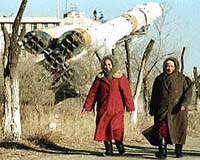
Russian Technologies Can Put Cosmonauts On Moon
Moscow, Russia (SPX) Dec 02, 2005 Despite Russia's 30-fold disadvantage in financing its space effort as compared with America's, it has greater chances of being the first in reaching the Moon this time, or perhaps the Mars. The paradox is that the Americans have put all their money in the transport system being developed by NASA (the National Aeronautics and Space Administration) and its budgetary division. According to an article in the influential newspaper "The Washington Post" of November 24, the American president's program of space research is having serious financial difficulties. Budgeted sums are just not enough. Most of them have been spent on upgrading the space shuttle system and looking for causes of the Columbia disaster of February 1, 2003. Reports also say that the idea is mooted to abandon the shuttle program altogether and save money for lunar and Martian missions. But such a step is unlikely to meet the emerging deficit in NASA's budget, which may grow to $6 billion at the peak of preparations (2006-2010) for interplanetary expeditions. Only extra cash injections can allow the agency to develop and build a new generation manned spacecraft by 2012 that is necessary for a lunar mission scheduled by President Bush for 2020. At the moment, however, the White House is flatly refusing to commit any more money to the space effort. It appears that American astronautics is hostage to fortune, in fact, to one of its own programs, or rather to the enormous sums sunk into its implementation. However, the odds are that it is neither shuttle craft, which can be operational for a long interim period, nor the overspending, that are plaguing ambitious American space projects. The likeliest explanation is the sheer size of the task that keeps NASA from focusing on specific projects and grasping how much it needs to spend on each of them. Meanwhile, Russian technologies, despite falling well behind in financing terms, promise to put cosmonauts on the Moon's surface in seven to nine years' time, with the whole exercise to cost no more than $2 billion. "We could bring about a landing," said Nikolai Sevastyanov, president of the Energia Rocket and Space Corporation, "as early as 2012-2014 by using the technology of Soyuz-type spacecraft. If we had a $2 billion program, we could land on the Moon after mounting only three expeditions." It is believed in the corporation that the first step should be to fly round the Moon, then try a circular orbit and land a lunar module, and only then to put a man on its surface. The Energia chief emphasized: "a mission to the Moon can be financed only by the state, but no such task is set yet." But if the need arises, Russia already has the first launch of its space shuttle "Kliper" scheduled for 2012. "The first regular lift-off is scheduled for 2012, while a complete transport system will be in place by 2015. The "Kliper" will be able to orbit and deorbit payloads between 500 kilograms and 1.5 tons. It can carry a crew of six: two trained cosmonauts and four untrained 'civilians'," noted Sevastyanov. In the opinion of the Energia chief regarding a manned mission to the Mars, it must be an international endeavor. The space programs of the two countries are dictating a cast-iron logic for development - close cooperation in addressing global questions concerning the study of the Universe is necessary. Community Email This Article Comment On This Article Related Links SpaceDaily Search SpaceDaily Subscribe To SpaceDaily Express Mars News and Information at MarsDaily.com Lunar Dreams and more
 SMART 1 Uses New Imaging Technique In Lunar Orbit
 Paris, France (ESA) Dec 28, 2005
ESA's SMART-1 spacecraft has been surveying the Moon's surface in visible and near-infrared light using a new technique, never before tried in lunar orbit. |
|
|

| The content herein, unless otherwise known to be public domain, are Copyright 1995-2006 - SpaceDaily.AFP and UPI Wire Stories are copyright Agence France-Presse and United Press International. ESA PortalReports are copyright European Space Agency. All NASA sourced material is public domain. Additionalcopyrights may apply in whole or part to other bona fide parties. Advertising does not imply endorsement,agreement or approval of any opinions, statements or information provided by SpaceDaily on any Web page published or hosted by SpaceDaily. Privacy Statement |