|
 |
 |
 |
 |
 |
 |
 |
 |

 |
Russian State Commission Clears Cluster For Countdown
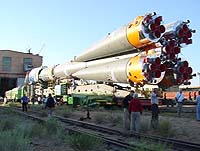
Moscow - July 12, 2000 - The launch of the first pair of Cluster II spacecraft was given the final go-ahead yesterday in a series of reviews to assess the readiness status of all components. Officials from ESA, the French-Russian Starsem consortium which has provided the Soyuz-Fregat launcher, and the Russian Aerospace Agency which operates the Baikonur Cosmodrome, participated in the review process. The first to take place was the Launch Readiness Review, which was chaired by the ESA Science Director, Professor Roger Bonnet. Also present were Starsem Chairman Jean-Yves Le Gall, Cluster II project manager John Ellwood, Cluster II deputy project manager Alberto Gianolio, and Patrick Bonguet, Starsem Director of Operations. After examining the status of the first two Cluster spacecraft (FM 6 and FM 7), the Fregat upper stage, the Soyuz launch vehicle, and the ground segment, the review board announced that it was satisfied with the state of preparation of all launch elements. This was followed by the Transfer Readiness Review, which was co-chaired by Starsem, ESA and RKA. The purpose of the review was to agree authorisation of the transfer of the launch vehicle, with its Cluster payload, to the launch pad. After a mission overview, the readiness of all hardware and software components and of the ground segment, along with all non-conformances identified during the launch preparation operations, were assessed. Professor Bonnet, Jean-Yves Le Gall, Mr. Soldatenkov -- Deputy General Designer of TsSKB, the company in charge of the Soyuz launcher, and Mr. Baikine -- Deputy General Designer of NPO-Lavotchkin, the company responsible for the Fregat Upper Stage -- concurred that all systems are ready for the roll-out to the launch pad. Later in the day, the Russian State Commission, co-chaired by Professor Bonnet, by Jean-Yves Le Gall and by General Kuznetsov, RKA Deputy Managing Director, having received the readiness status from all parties involved in the roll-out and subsequent pad operations, gave the final green light for the Soyuz-Fregat launch on the afternoon of 15 July. The Soyuz-Fregat launcher, to which the Cluster spacecraft have already been integrated, subsequently completed its horizontal roll out to the pad and erection on the launch tower, at 7.30 local time (03.30 CET) on 12 July. The entire Soyuz stack, weighing about 300 tonnes, was transported by train at slow walking pace from the MIK Soyuz integration facility to launch pad 6. After the launch vehicle was lifted upright, final preparations began for the launch in three days time.
Each spacecraft will carry the following complement of 11 identical instruments:
|
Greenbelt - July 12, 2000 - An international collaboration will investigate a struggle that's raging in space -- a turbulent battle between the Earth's magnetic field and a solar wind blowing about one to two million miles per hour. Four satellites, flying in formation, will be used to examine this complex interaction between the Earth and the Sun. It all begins with the first of two launches of the European Space Agency's (ESA) Cluster spacecraft. The first launch is set for July 15 at 8:43 a.m. EDT in Baikonur, Kazakhstan. Two satellites will be carried into orbit by a Russian Soyuz rocket. A second pair is scheduled to launch August 9. "Cluster is just one example of the marvelous and sophisticated space exploration fleets that can be outfitted through the unselfish cooperation between ESA and NASA," said Larry Christensen, Cluster project manager at NASA's Goddard Space Flight Center, Greenbelt, MD. During its two-year mission, the quartet of satellites will travel around the Earth in a tetrahedral -- or triangular pyramid -- formation, collecting data where the solar wind, which is a gas comprised primarily of electrons and protons, impacts the Earth's magnetic field. The unprecedented detail provided by Cluster will allow scientists to assemble the first thorough three-dimensional maps of the environment that surrounds and protects our planet. The current Cluster mission replaces the original spacecraft, which were lost in 1996 shortly after liftoff. "Instruments aboard Cluster will provide the only 3-D fast diagnostic tool for studying the Sun-Earth connection and entry of plasma into the magnetosphere," said Dino Machi, Cluster program manager at Goddard. "The mission is extremely important because particularly energetic particles can have a dramatic effect on human activities, disrupting electrical power and telecommunications or causing serious anomalies in satellite operations, especially those in geostationary orbit." Cluster will join the Solar and Heliospheric Observatory (SOHO), launched in December 1995, as the second cooperative solar-terrestrial project between ESA and NASA. NASA will provide project management and funding for the U.S. principal investigator and U.S. co-investigator hardware investigations, assist ESA with launch and early operations support, provide scheduling support and transmit WBD data from Cluster to the University of Iowa via the Agency's Deep Space Network.
|
Cluster Instrument Sites
 Memory Foam Mattress Review |
Newsletters :: SpaceDaily :: SpaceWar :: TerraDaily :: Energy Daily XML Feeds :: Space News :: Earth News :: War News :: Solar Energy News |
 Satellite Launch To Boost DTH In India
 Calcutta, India (SPX) Dec 28, 2005
|
|

|
|
|
|
|
|
|
|
|
|
|
|
| The content herein, unless otherwise known to be public domain, are Copyright 1995-2006 - SpaceDaily.AFP and UPI Wire Stories are copyright Agence France-Presse and United Press International. ESA PortalReports are copyright European Space Agency. All NASA sourced material is public domain. Additionalcopyrights may apply in whole or part to other bona fide parties. Advertising does not imply endorsement,agreement or approval of any opinions, statements or information provided by SpaceDaily on any Web page published or hosted by SpaceDaily. Privacy Statement |