|
 |
 |
 |
 |
 |
 |
 |
 |

 |
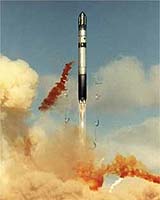
Russian Rocket Fails Shortly After Launch
Moscow, Russia (SPX) Jul 27, 2006 A Russian Dnepr rocket failed 86 seconds after liftoff Wednesday, the RIA-Novosti news agency reported. The rocket, a former Soviet RS-20 intercontinental ballistic missile, carried 17 micro-satellites - as well as the first Belorussian spacecraft, called Belka. It apparently failed after the second stage was ignited. The Interfax news agency reported that the rocket 25 kilometers (15 miles) south of the launch pad, Yuri Nosenko, deputy chief of Roskosmos told Interfax. "There was no harm to any of the towns and villages on the nearby territories," he said. The satellite constellation had been designed for a five-year remote-sensing mission. Called baumanets, the microsatellites were due to follow orbits ranging from 300 kilometers to 900 kilometers (185 miles to 560 miles) above Earth. The rocket had a mass at liftoff of approximately 250 tons. Its length was 34.3 meters (111 feet) and a diameter of 3 meters (10 feet) and was capable of putting into orbit a payload of up to 3.7 tons. Community Email This Article Comment On This Article Related Links - Launch Pad at Space-Travel.com
 Arianespace Readies Syracuse 3B Satellite For Launch
 Kourou, French Guyana (SPX) Jul 25, 2006
Arianespace's upcoming Ariane 5 ECA flight will match a range of payloads for its dual-satellite launch. The next mission, scheduled for Aug. 11, will carry France's Syracuse 3B military relay platform, along with the civilian JCSAT-10 telecommunications spacecraft for Japan's JSAT Corp. |
|
|

| The content herein, unless otherwise known to be public domain, are Copyright 1995-2006 - SpaceDaily.AFP and UPI Wire Stories are copyright Agence France-Presse and United Press International. ESA PortalReports are copyright European Space Agency. All NASA sourced material is public domain. Additionalcopyrights may apply in whole or part to other bona fide parties. Advertising does not imply endorsement,agreement or approval of any opinions, statements or information provided by SpaceDaily on any Web page published or hosted by SpaceDaily. Privacy Statement |