|
 |
 |
 |
 |
 |
 |
 |
 |

 |
Russian Glonass Navigation System Available To India
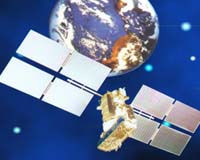
Bangalore (RIA Novosti) Jan 23, 2007 Russia's global space navigation system Glonass is available for India to use, Russia's defense minister said Monday. Sergei Ivanov, who is also a deputy prime minister, said Moscow and New Delhi had agreed to launch Glonass M satellites with the help of Indian carrier rockets, and to create new-generation navigation satellites. "Two agreements are to be signed to develop cooperation on the program during the Russian president's forthcoming visit [January 25-26]," Ivanov said. Earlier, the head of Russia's Federal Space Agency, Anatoly Perminov, said Russia and India plan to jointly use Glonass. Glonass, a Russian version of the U.S. Global Positioning System (GPS), is designed for both military and civilian purposes, and allows users to identify their positions in real time. It can also be used in geological prospecting. President Vladimir Putin ordered in December 2005 that the system be ready by 2008 and in March this year Ivanov said Glonass will be available to domestic consumers for military as well for civilian purposes by the end of 2007. Perminov said earlier Russia is in talks with the United States and the European Space Agency to prepare agreements on the use of Glonass jointly with GPS and Galileo satellite navigation systems. The agency plans to have 18 satellites in orbit by late 2007 or early 2008, and a full orbital group of 24 satellites by the end of 2009, he said. In November Russian Defense Minister Sergei Ivanov said Russia will lift all precision restrictions, from the start of 2007, in the use of Glonass to enable accurate and unlimited commercial use of the military-controlled global positioning system. Current restrictions limit the accuracy for civilian users of Glonass to 30 meters. The first launch under the Glonass program took place October 12, 1982, but the system was only formally launched September 24, 1993. Andrei Kozlov, the head of the Reshetnev Research and Production Center in the Siberian city of Krasnoyarsk, Russia's leading spacecraft manufacturer, said earlier the Glonass system has 13 satellites in orbit. The satellites currently in use are of two modifications - Glonass and its updated version Glonass-M. Glonass-M has a longer service life of seven years and is equipped with updated antenna feeder systems and an additional navigation frequency for civilian users. A future modification, Glonass-K, is an entirely new model based on a non-pressurized platform, standardized to the specifications of the previous models' platform, Express-1000. Glonass-Ks' estimated service life has been increased to 10-12 years and a third "civilian" L-range frequency was added. Tests on Glonass-K satellites are scheduled for 2007.
Source: RIA Novosti Community Email This Article Comment On This Article Related Links GPS Applications, Technology and Suppliers GPS Applications, Technology and Suppliers
 Stolen GPS Lead Police To Thieves
 Washington (AFP) Jan 22, 2007
Thieves who stole global positioning systems (GPS) from a warehouse in New York state were apprehended after authorities activated the tracking devices to locate them, police said Monday. Fourteen GPS were stolen last week from a warehouse in Babylon, New York. The town had planned to use them to track its municipal fleet of vehicles. |
|
|

| The content herein, unless otherwise known to be public domain, are Copyright 1995-2006 - SpaceDaily.AFP and UPI Wire Stories are copyright Agence France-Presse and United Press International. ESA PortalReports are copyright European Space Agency. All NASA sourced material is public domain. Additionalcopyrights may apply in whole or part to other bona fide parties. Advertising does not imply endorsement,agreement or approval of any opinions, statements or information provided by SpaceDaily on any Web page published or hosted by SpaceDaily. Privacy Statement |