
 |
 |
 |
 |
 |
 |
 |
 |
 |

 |
Russian Cosmonauts Lament Cash Shortage
Moscow (AFP) Oct 04, 2004 Russian cosmonauts Monday denounced what they said were shortages in government financing of the space industry, saying Russia had lost its Soviet-era status of space pioneer. "In the past 10 years, the volume of financing for manned space exploration has plummetted by a factor of 15 or 20," Vladimir Senkevich, the president of Russia's Tsyolkovsky Academy of Astronautics, told reporters Monday. "Even India spends more than us on space, without mentioning Japan, China, France, Germany and a series of other European countries." Mikhail Marov, a member of the Russian Academy of Science, said a series of space projects were being postponed or even cancelled due to lack of funding. He cited a project to launch an automated satellite to take soil samples on the moon, Mars, Venus, and on asteroids and bring them back to earth for analysis. "This project is ready, but is constantly being postponed because of insufficient financing," he said. "We are poor, but we are incredibly rich in intellect," he said, lamenting that increasing numbers of young astronauts were leaving their jobs "to feed their families." Astronauts told reporters that Russia had lost the status of leading space power it had in Soviet times, stressing their country now only had 100 satellites in orbit. According to them, the United States -- Russia's traditional rival in space exploration -- has around 400 satellites in space, 120 of them military. They also warned about the dangers of a collapse of Russian astronautics. "All mankind is living under threats ... military, technological, social, cosmo-planetary. Only astronautics, with its global possibilities, can counter and prevent such threats," said Ivan Meshcheryakov, the Astronautics Academy's vice-president. On a more optimistic note, Senkevich said Russia could soon launch a flight to the moon and would soon begin experiments aimed at sending cosmonauts on lenghthy space missions of up to 500 days. "With favourable financing, Russia could launch a research manned flight to the moon in 2021-2023," he said. Community Email This Article Comment On This Article Related Links SpaceDaily Search SpaceDaily Subscribe To SpaceDaily Express Space Station News at Space-Travel.Com
 NASA Had No Choice But To Buy Soyuz Flights
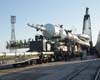 Washington DC (SPX) Jan 09, 2006
NASA's announcement last week that it will pay Roskosmos $43.6 million for a round-trip ride to the International Space Station this spring, and an equivalent figure for an as-yet-undetermined number of future flights to the station until 2012, represents the agency's acknowledgment that it had no alternative. |
|
|

| The content herein, unless otherwise known to be public domain, are Copyright 1995-2006 - SpaceDaily.AFP and UPI Wire Stories are copyright Agence France-Presse and United Press International. ESA PortalReports are copyright European Space Agency. All NASA sourced material is public domain. Additionalcopyrights may apply in whole or part to other bona fide parties. Advertising does not imply endorsement,agreement or approval of any opinions, statements or information provided by SpaceDaily on any Web page published or hosted by SpaceDaily. Privacy Statement |

