
 |
 |
 |
 |
 |
 |
 |
 |
 |

 |
Russia row shows NATO needs reality check: IISS
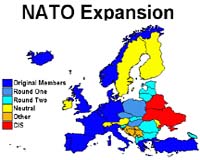
London (AFP) Sept 18, 2008 NATO would be making a major strategic error trying to expand in the face of Russian anger, a respected international think tank said Thursday. NATO must not play "Russian roulette" with the Kremlin as it considers how to respond to Moscow's "disproportionate" use of force in Georgia, said the London-based International Institute for Strategic Studies. The IISS questioned whether the US-led alliance should "lock horns" with Russia, given its strategic need for support from Moscow in flashpoints such as Afghanistan and Iran. Launching its "Strategic Survey 2008" annual review of global security, IISS chief John Chipman played down the risk of a new Cold War developing between the West and Russia. "Neither side wants one and the stakes are too low to warrant one," he said. However, the Georgia-Russia conflict does mark "the distinct end of the romantic phase of the post-Cold War order," he added. "We are now entering an era... where international diplomatic activity will be more plural. America is unable now to shape the international agenda alone and needs international partners." NATO reaffirmed its pledge of eventual membership for Georgia and Ukraine after the Russia-Georgia conflict last month. "NATO must not transform its expansion policy into a game of Russian roulette," Chipman said, blasting Georgia's actions in South Ossetia as "irresponsible". "A policy of NATO enlargement now, we believe, would be a strategic error. Normally when military alliances enlarge it is to gain strength themselves, it is not to assume new strategic liabilities." He also called Moscow's reaction "disproportionately strong," saying the spread of its army throughout Georgia was "unjustified" and Russia's "bad temper" was now "almost an instrument of its foreign policy". IISS Russia expert Oksana Antonenko said the European Union's mediation showed it had the potential to become "a genuine player in the Caucasus" -- though it was lucky France held the EU presidency during the Georgia crisis. Chipman added that it was not a "wise policy" for NATO to push for Ukrainian membership while the population was split on the issue. The IISS found that "significant progress" had been made in Iraq in 2008, but to make it permanent, the ruling elite needed to find ways to compromise on political and revenue issues without resorting to violence. Attention was migrating away from Iraq to Afghanistan and the worsening situation on the Pakistan border, Chipman said. New Pakistani President Ali Asif Zardari had to make fighting terrorism and Islamist militancy there his top priority, though the army remains unwilling or unable to deal with the resurgent Taliban, he said. Zardari "will need to balance the conflicting interests of growing US pressure for military strikes in the tribal areas with the Pakistani army's decreasing tolerance for such attacks" -- which could place the government at risk, Chipman explained. Meanwhile diplomatic efforts to stem the nuclear proliferation challenges posed by Iran and North Korea are both deadlocked, he said. North Korea last month stopped disabling its nuclear plants, which it agreed to do under a six-nation disarmament deal, and is taking initial steps to restart its plutonium-producing nuclear reactor. "It will take North Korea less than one year to undo the steps that up until August it was taking to disable its declared nuclear facilities," said Chipman. "Uncertainty about the health of North Korean leader Kim Jong-Il solidifies the stalemate that is likely to continue at least until a new US president takes office," he added. Washington's individual share of global power was in relative decline but the United States retains the most impact on global stability, the IISS found. Its prospective partners in Europe, the Middle East and Asia need to be more assertive in developing initiatives which Washington could comfortably join. "The quality of these initiatives will determine whether the post-unipolar moment will be more or less good for international security." Community Email This Article Comment On This Article Share This Article With Planet Earth
Related Links
 NATO to examine military implications of Georgia conflict
 Brussels (AFP) Sept 17, 2008
NATO defence ministers are set to meet Thursday in London for talks overshadowed by Georgia's conflict with Russia and the effects it will have on the military alliance's future. |
|
|

| The content herein, unless otherwise known to be public domain, are Copyright 1995-2007 - SpaceDaily.AFP and UPI Wire Stories are copyright Agence France-Presse and United Press International. ESA Portal Reports are copyright European Space Agency. All NASA sourced material is public domain. Additional copyrights may apply in whole or part to other bona fide parties. Advertising does not imply endorsement,agreement or approval of any opinions, statements or information provided by SpaceDaily on any Web page published or hosted by SpaceDaily. Privacy Statement |
 del.icio.us
 Digg
Digg Reddit
 YahooMyWeb
 Google
 Facebook