|
 |
 |
 |
 |
 |
 |
 |
 |

 |
Russia, US Set To Lock Horns Over Missile Shield
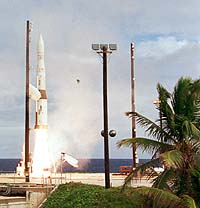
Nago, Japan (AFP) July 20, 2000 - Russian President Vladimir Putin looks set to lock horns with US President Bill Clinton over a US scheme for a ballistic missile shield at a Group of Eight summit here. In a pre-summit Asian tour, Putin won backing from Chinese President Jiang Zemin and North Korean supreme leader Kim Jong-Il against the national missile defence (NMD) scheme. Barely two weeks ago, the United States admitted an interceptor rocket had failed to shoot down an incoming dummy warhead during a 100-million-dollar test of its prototype NMD system. The botched test was an acute embarrassment to the Pentagon and Clinton, who is due to take a decision on whether to deploy the 60-billion-dollar system by the year's end. The United States was already under pressure to defend the NMD from Russia and its allies at a G8 foreign mininsters last week in the southern Japanese city of Miyazaki. But Putin appeared to be turning up the heat ahead of the three-day G8 summit starting Friday in Naha, a beachside city on the southern Japanese island of Okinawa. On Tuesday he issued a joint statement with Jiang specifically aimed at the system. "Russia and China appeal to the international community to pay great attention to those countries who are trying to develop by force an anti-missile defence system which could upset the world's strategic balance," it said. On Wednesday, the Russian leader and Kim Jong-Il also signed a memorandum opposing any changes to the 1972 Anti-Ballistic Missile (ABM) treaty, ITAR-TASS said. And he packed further ammunition by winning an offer from Pyongyang to abandon missile development in return for rocket technology to help a supposed space program. Washington, which cites the threat of a ballistic missile attack from states like North Korea as a reason for the NMD, reacted coolly to Putin's announcement. "I would remind you that the North Koreans demonstrated ballistic missile capability with what they called a space or satellite launch," one US official said. Pyongyang test-fired a ballistic missile over Japan without warning in August 1998, stunning the region. The Stalinist regime insisted it had merely put into orbit a satellite emitting revolutionary songs. "I understand that this is a question to be discussed particularly between the United States and Russia," Foreign Minister Yohei Kono told a news conference this week. "Russian President Putin is expected to discuss with US President Clinton questions related to the NMD," Kono said. In Miyazaki last week, Russian Foreign Minister Igor Ivanov joined other G8 representatives in questioning the fall-out from any deployment of the NMD system. US Deputy Secretary of State Strobe Talbott had to fend off concerns that the unproven shield threatened to undermine the ABM treaty. Copyright 2000 AFP. All rights reserved. The material on this page is provided by AFP and may not be published, broadcast, rewritten or redistributed. CommunityEmail This Article Comment On This Article Related Links Space
 Satellite Launch To Boost DTH In India
 Calcutta, India (SPX) Dec 28, 2005
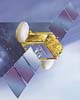
The successful launch Thursday of India's heaviest satellite from spaceport of Kourou in French Guyana may have boosted the country's space research efforts to yet another level, but it has also lifted the spirits of at least three Direct-To-Home televisions broadcasters, one of which has been waiting for years to launch its services in India. |
|
|

|
|
|
|
|
|
|
|
|
|
|
|
| The content herein, unless otherwise known to be public domain, are Copyright 1995-2006 - SpaceDaily.AFP and UPI Wire Stories are copyright Agence France-Presse and United Press International. ESA PortalReports are copyright European Space Agency. All NASA sourced material is public domain. Additionalcopyrights may apply in whole or part to other bona fide parties. Advertising does not imply endorsement,agreement or approval of any opinions, statements or information provided by SpaceDaily on any Web page published or hosted by SpaceDaily. Privacy Statement |