|
 |
 |
 |
 |
 |
 |
 |
 |

 |
Russia Working To Upgrade ICBM Arsenal
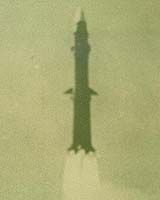
UPI Outside View Commentator Moscow (UPI) Apr 17, 2006 The chief designer of Russia's intercontinental ballistic missiles has announced coming changes in the country's ICBMs. Russia will announce changes in its strategic nuclear capability by the end of the year, said Yury Solomonov, head and chief designer of the Moscow Institute of Thermal Technology, the designer of ground- and sea-launched nuclear missiles. The chief designer, who has the ground-launched Topol-M or SS-25 Sickle and the sea-launched Bulava-30 or SS-NX-30 intercontinental ballistic missile systems on his record, did not enlarge on details but stated that Moscow would have no less than 2,000 nuclear warheads by 2011, when the U.S.-Russian Strategic Offensive Reductions Treaty will be nearing expiry. This is in line with the SORT's requiring that both sides should reduce their nuclear stockpiles to 1,700-2,200 warheads by Dec. 31, 2012. The statement was prompted by a question how Russia was going to maintain the SORT-approved number of warheads as many decommissioned 10-MIRV R-36MUTTKh/R-36M2 Voevodas or SS-18 Satan and six-MIRV UR-100NUTTKhs or SS-19 Stiletto were being replaced every year by single-warhead silo-based and road-mobile RT-2PM2 Topol-Ms. "I cannot answer this question in detail right now," Solomonov said. "This is a confidential issue pertaining to the relations between our country and the United States. However, we are going to notify Washington of upcoming changes in our strategic nuclear forces within two months, and, I think, the information will become public by the end of the year." Importantly, Solomonov said Russia was ahead of the rest of the world in missile defense penetration capability by at least 15 to 20 years. In the light of his earlier remarks that technologically both new missiles could carry no less than three warheads, defense experts are now convinced the announced changes will have to do with the number of warheads per missile. Moreover, media reports, citing Moscow's recent disclosure of a six-MIRV Bulava, designed as part of Russia's effort to implement the Memorandum to START I which expires in 2009, suggested the number of MIRVs per missile was likely to grow to 10 shortly. Solomonov made two other remarks that look important enough if put together. As the first road mobile missile regiment is to enter active service in 2008, the SS-NX-30 also has a three-year flight test program ahead, which means that the first Bulava-armed nuclear submarine Yury Dolgoruky Project 955 Borei will be commissioned in the same year and, probably, that the date should be seen as the next landmark for the qualitative development of Russia's nuclear capability. (Viktor Litovkin is a military commentator for the RIA Novosti news agency. This article is reprinted by permission of RIA Novosti.) (United Press International's "Outside View" commentaries are written by outside contributors who specialize in a variety of important issues. The views expressed do not necessarily reflect those of United Press International. In the interests of creating an open forum, original submissions are invited.)
Source: United Press International Community Email This Article Comment On This Article Related Links - Learn about nuclear weapons doctrine and defense at SpaceWar.com Learn about missile defense at SpaceWar.com All about missiles at SpaceWar.com Learn about the Superpowers of the 21st Century at SpaceWar.com
 Iranian Suicide Squads Ready To Hit US British Targets
 London (AFP) Apr 16, 2006
Iran has formed battalions of suicide bombers to hit American and British targets if its nuclear installations are attacked, The Sunday Times newspaper said. According to Iranian officials, 40,000 trained suicide bombers were ready to strike, the British weekly broadsheet said. |
|
|

| The content herein, unless otherwise known to be public domain, are Copyright 1995-2006 - SpaceDaily.AFP and UPI Wire Stories are copyright Agence France-Presse and United Press International. ESA PortalReports are copyright European Space Agency. All NASA sourced material is public domain. Additionalcopyrights may apply in whole or part to other bona fide parties. Advertising does not imply endorsement,agreement or approval of any opinions, statements or information provided by SpaceDaily on any Web page published or hosted by SpaceDaily. Privacy Statement |