|
 |
 |
 |
 |
 |
 |
 |
 |

 |
Russia To Make Proposals On Building Non-Strategic Missile Defense For Europe
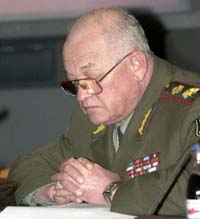
Moscow - (Interfax) April 24, 2001 The Russian president's strategic security advisor Marshal Igor Sergeyev and Head of the Russian Defense Ministry's Main Department for International Military Cooperation Col. Gen. Leonid Ivashov are flying to Brussels on Wednesday, bringing along proposals for creating a non-strategic missile defense system for Europe. Defense Ministry sources have told Interfax that Sergeyev and Ivashov will attend a meeting of the Russia-NATO Joint Permanent Committee, set for April 26, at the level of ambassadors. The meeting will focus on the Russian proposals. Sergeyev has told Interfax that the European countries' interest in the Russian proposal has not waned. "On the contrary, it has increased," he said, noting that "Russia's main goal is to preserve global strategic stability, enhance mutual trust between the states and make control over the nonproliferation of missiles and missile technologies more effective." Sources in the Russian General Staff have told Interfax that Moscow's proposals on the creation of a non-strategic missile defense system for Europe "do not undermine stability in the region, as such systems are incapable of combating strategic ballistic missiles." A highly-placed representative of the General Staff said that specialized non-strategic missile complexes may be jointly developed and built. Such a system could be supplied to joint permanent-readiness units similar to the rapid-deployment missile defense forces, he said. Meanwhile, in comments late last week, Russia has indicated that it is prepared to enter into a dialogue with the US on missile defense. "In discussing with the United States issues in strategic stability Russia is prepared not only to advocate its views, but also to give heed to legitimate U.S. concerns in the field of missile defense, Russian Foreign Minister Igor Ivanov told the first convention of the Russian Association for International Research in Moscow on Friday. Moscow is prepared to work together in detecting and evaluating the existing threats and working out countermeasures if this is needed, he said. On the other hand, these issues should be tackled without destroying the 1972 ABM Treaty and the entire structures of understandings on disarmament and arms control, Ivanov said. This will be feasible if the Russian proposals on an all-European missile defense and on missile nonproliferation are accepted, he said. In its relations with the United States Russia wants to "reliably protect its national interests through partnership and search for mutually acceptable solutions to problems rather than through rivalry and confrontation," Ivanov said. Relations with the new U.S. Administration started in a way that Russia did not want, Ivanov said. "Nobody can make Russia abandon its strategy that works for long-term, rather than short-term interests, of this country and the United States itself," he said. Ivanov said he had succeeded in his first contacts with U.S. Secretary of State Colin Powell in having this policy understood. "This is essentially important because the agenda of the Russian-U.S. dialogue is full of issues of key importance for the future of international security," he said. Ivanov hopes that in the course of his upcoming visit to Washington early in May he and Powell will be able to start a dialogue "on all important issues in bilateral and international relations." Russia is prepared for this dialogue, he said. Russian Foreign Minister Igor Ivanov has said that he intends to discuss a wide range of issues with U.S. Secretary of State Colin Powell during their May 18 meeting in Washington. On Friday he said that during a Thursday evening telephone conversation with Powell they agreed to begin a meaningful dialogue on the entire set of bilateral relations, in particular in the context of the upcoming Russian-U.S. summit. Ivanov said he intended to mull all aspects of START and ABM issues with his American counterpart. Moscow and Washington have launched joint efforts on a number of key international problems, Ivanov said. For instance, a joint working group for Afghanistan is beginning to operate and consultations are expected to begin soon on the situation in the Middle East and the Persian Gulf. In related news, the Ukrainian Deputy Foreign Minister Ihor Kharchenko told a briefing in Kyiv on Friday. that the best way to overcome the tension over the ABM Treaty would be for the United States and Russia to work out an understanding on the issue, "Ukraine cannot idly watch the developments, because, for various reasons, it is interested in reliable regional security," he said Community Email This Article Comment On This Article Related Links SpaceDaily Search SpaceDaily Subscribe To SpaceDaily Express Military Space News at SpaceWar.com
 Canada To Seek International Pact Banning Weapons In Space
 Ottawa (AFP) Jan 11, 2006
Canadian Prime Minister Paul Martin will seek an international pact to ban weapons in space if his Liberals are returned to power in a January 23 election, according to the party platform. |
|
|

|
|
|
|
|
|
|
|
|
|
|
|
| The content herein, unless otherwise known to be public domain, are Copyright 1995-2006 - SpaceDaily.AFP and UPI Wire Stories are copyright Agence France-Presse and United Press International. ESA PortalReports are copyright European Space Agency. All NASA sourced material is public domain. Additionalcopyrights may apply in whole or part to other bona fide parties. Advertising does not imply endorsement,agreement or approval of any opinions, statements or information provided by SpaceDaily on any Web page published or hosted by SpaceDaily. Privacy Statement |