|
 |
 |
 |
 |
 |
 |
 |
 |

 |
Russia To Get New Mobile ICBMs
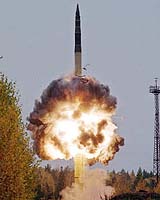
Moscow, Russia (RIA Novosti) Dec 18, 2006 Russian President Vladimir Putin and Defense Minister Sergei Ivanov recently visited the Teikovo strategic missile division, which placed the first regiment of unique mobile ground-based Topol-M intercontinental ballistic missiles on combat duty. The Russian Strategic Missile Force has received over 40 Topol silo-based ICBMs since 1997. However, unlike these earlier missiles, the mobile, hard-to-detect and interchangeable Topol-M ballistic missiles, which are immune to electromagnetic impulses, can be launched from a wide area. R and D and deployment costs were reduced because the new missile system retains the main engineering solutions of its predecessor. Moreover, the Topol-M can breach any existing anti-ballistic missile shield, including the highly expensive U.S. National Missile Defense system. It is therefore hardly surprising that Topol-M missiles will soon be the mainstay of Russia's Strategic Missile Force and replace other missiles that have been serving for over 20 years. The Topol-M missile has a lift-off weight of 47.2 metric tons, a range of over 10,000 km and carries a 1,200-kg warhead. The Russian Armed Forces, which suffered an all-out crisis in the 1990s, are now receiving new strategic offensive arms under an ambitious modernization program. Just like most other major powers, Russia is focusing on qualitative, rather than quantitative, military development in accordance with the global military-political situation. The United States has withdrawn from the 1972 ABM Treaty and resumed tests of tactical nuclear weapons. It also continues to stockpile (instead of destroying) nuclear warheads and Minuteman ICBM's, which it launches as drones for missile interceptors. Moscow, which is worried about these and many other factors, must react accordingly. Russia's rearmament program is largely motivated by tougher competition between the great powers for unimpeded access to raw materials, energy and science-and-technological resources. U.S. representatives attending a conference that was held simultaneously with the NATO summit in Riga discussed the possible use of power politics for dealing with countries which allegedly threaten European energy security. NATO can use its powerful military leverage and strategic potential to attain this goal. In this situation, Moscow has no choice but to rely on military force to defend its national interests. Consequently, Russia is attaching priority to maintaining and upgrading its strategic nuclear deterrent forces and aerospace defense system. The Russian Army has adopted Topol missiles; the Air Force is overhauling its strategic bombers; and the Navy has ordered Borei-class ballistic missile submarines. On April 5, the Government approved a project for expanding the aerospace defense system up to the year 2016 and beyond. According to the plan, the Russian Army is to adopt state-of-the-art early-warning, reconnaissance, telecommunications, and automated-control systems, as well as missile interceptors. Moscow plans to spend nearly five trillion rubles, or about $200 billion, on weapons development, procurement, modernization and repairs in the next few years. Such massive expenses are motivated by the need to renew the country's strategic nuclear forces, as well as by economic considerations. Russian authorities hope that the growing national defense industry will facilitate cost-effective high-tech production and create thousands of new jobs. In this sense, the modernization of the country's strategic nuclear forces through the procurement of Topol-M missiles is an extremely promising development. It is hardly surprising that the Russian Armed Forces plan to receive another batch of Topol missiles next year. Source: RIA Novosti Community Email This Article Comment On This Article Related Links Learn about nuclear weapons doctrine and defense at SpaceWar.com Learn about nuclear weapons doctrine and defense at SpaceWar.com Learn about missile defense at SpaceWar.com All about missiles at SpaceWar.com Learn about the Superpowers of the 21st Century at SpaceWar.com
 Japan Does Not See North Korea As A Nuclear Power Foreign Minister
 Tokyo (AFP) Dec 17, 2006
Japan's Foreign Minister Taro Aso reiterated Sunday that Japan does not consider North Korea a nuclear power as envoys gather in Beijing for six-nation talks after a hiatus of more than a year. Asked by reporters if Japan recognizes the North as a nuclear power, Aso said, "No, it doesn't." |
|
|

| The content herein, unless otherwise known to be public domain, are Copyright 1995-2006 - SpaceDaily.AFP and UPI Wire Stories are copyright Agence France-Presse and United Press International. ESA PortalReports are copyright European Space Agency. All NASA sourced material is public domain. Additionalcopyrights may apply in whole or part to other bona fide parties. Advertising does not imply endorsement,agreement or approval of any opinions, statements or information provided by SpaceDaily on any Web page published or hosted by SpaceDaily. Privacy Statement |