|
 |
 |
 |
 |
 |
 |
 |
 |

 |
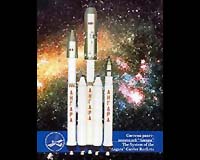
Russia Tests Engine For Angara Carrier Rocket
Moscow (RIA Novosti) Dec 10, 2007 Russia has successfully conducted preliminary tests of an engine for the first stage of the new-generation Angara carrier rocket, the Khrunichev State Research and Production Center said on Friday. The RD-191 oxygen-kerosene engine has been developed by Energomash research and production center for a new family of Russian launch vehicles based on a common core booster. "Experts have tested the performance of rudders and a hydraulic system [of the engine]," a Khrunichev spokesperson said. "Next week, we will conduct another set of rudder tests." The Angara family of carrier rockets, designed by the Khrunichev center, will compliment, and eventually replace, the existing line of Rockot and Proton boosters. Angara is a booster with light-weight, medium, and heavy-lift derivatives. The maximum launch weight is 773 metric tons, with a payload up to 24.5 tons, and an orbit altitude of 200km (124 miles). The Angara development program, launched by presidential decree in 1995, has suffered a number of setbacks and delays. However, Russia's First Deputy Prime Minister Sergei Ivanov said in October that the Angara launch facilities at the Plesetsk space center in northwest Russia would be complete in July-August 2010, and that the first launch tests ought to be conducted in the first quarter of 2011.
Source: RIA Novosti Community Email This Article Comment On This Article Related Links Launch Pad at Space-Travel.com
 United Launch Alliance Launches 2nd COSMO Satellite
 Vandenberg AFB CA (SPX) Dec 10, 2007
A United Launch Alliance Delta II rocket successfully launched the second Italian-built Constellation of Small Satellites for Mediterranean Basin Observation or COSMO-SkyMed 2 satellite at 6:31 p.m. PST, today. Blasting off from Space Launch Complex 2, it marked the third successful Delta II vehicle launch by Boeing Launch Services, a division of Boeing Network and Space Systems, of a commercial satellite. |
|
|

| The content herein, unless otherwise known to be public domain, are Copyright 1995-2007 - SpaceDaily.AFP and UPI Wire Stories are copyright Agence France-Presse and United Press International. ESA Portal Reports are copyright European Space Agency. All NASA sourced material is public domain. Additional copyrights may apply in whole or part to other bona fide parties. Advertising does not imply endorsement,agreement or approval of any opinions, statements or information provided by SpaceDaily on any Web page published or hosted by SpaceDaily. Privacy Statement |