
 |
 |
 |
 |
 |
 |
 |
 |
 |

 |
Russia Still Looking For Quick Bird Satellite Fault
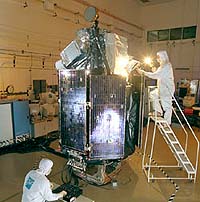
Moscow (Interfax) Nov. 25, 2000 Russian specialists cannot yet reach a final conclusion about the reasons behind the fault of the U.S. Quick Bird satellite launched in the small hours of November 21 from the Russian cosmodrome Plesetsk. An ad hoc commission formed at Plesetsk, having analyzed all technical documentation and the course of the pre-launch routine, has concluded that the teams involved in launching the Kosmos-3M booster rocket with the U.S. satellite aboard performed their duties irreproachably, a source with Russian space circles has told Interfax. The fuelling of the rocket and the pre-launch tests on the control systems were carried out fully in line with prescribed regulations. Media reports alleging that Quick Bird's docking with the Russian rocket was carried out exclusively by American specialists do not correspond to reality, the source said. All operations were conducted at an assembly test facility jointly by U.S. specialists, experts from Omsk's aerospace company 'Polyot' and representatives from the Russian Strategic Missile Forces. In the experts' view, the accident occurred after the first spiral due to the incorrect functioning of the flight control system when the Kosmos-3M's second-stage engines were operating. All this happened out of reach of the Russian ground instrumentation control centers' radar. The spacecraft might have gone into a non-calculated orbit and therefore could not be located by the control instrumentation centers, the experts conjectured. They also said the satellite might have dropped to the ground. Preliminary calculations indicate that, in this case, its fragments could have fallen into the Atlantic near the Brazilian coast. At the moment, an ad hoc state commission is being formed comprising specialists from the Russian Aerospace Agency and Defense Ministry. The commission is to thoroughly analyze all telemetric information recorded by the ground instrumentation control centers located outside St. Petersburg. In addition, the Russian side has forwarded inquiries to the U.S. centers monitoring Quick Bird's flight with the use of telemetric information.
Community Email This Article Comment On This Article Related Links EarthWatch SpaceDaily Search SpaceDaily Subscribe To SpaceDaily Express The latest information about the Commercial Satellite Industry
 Stratos Steps Closer To Xantic Acquisition
 Bethesda MD (SPX) Jan 5, 2006
Stratos Global recently announced it had taken a step closer toward the completion of the acquisition of Xantic, having received positive advice from the Works' Council in the Netherlands, and executed a definitive agreement to purchase Xantic from KPN and Telstra Corporation. |
|
|

|
|
|
|
|
|
|
|
|
|
|
|
| The content herein, unless otherwise known to be public domain, are Copyright 1995-2006 - SpaceDaily.AFP and UPI Wire Stories are copyright Agence France-Presse and United Press International. ESA PortalReports are copyright European Space Agency. All NASA sourced material is public domain. Additionalcopyrights may apply in whole or part to other bona fide parties. Advertising does not imply endorsement,agreement or approval of any opinions, statements or information provided by SpaceDaily on any Web page published or hosted by SpaceDaily. Privacy Statement |
 Copyright 2000