|
 |
 |
 |
 |
 |
 |
 |
 |

 |
Russia Set To Dismantle 5 Nuclear Submarines By 2010
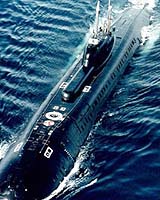
Vladivostok, Russia (RIA Novosti) Sep 13, 200 Russia will scrap five nuclear submarines decommissioned from the Pacific Fleet by 2010 under a joint project with Japan, a Japanese deputy foreign minister said Tuesday. The Victor class vessels will be dismantled under the Star of Hope program for the dismantlement of decommissioned nuclear submarines in Russia's Far East, which was adopted in 2003 during a visit of Japanese Prime Minister Junichiro Koizumi to Russia. Deputy Foreign Minister Shintaro Ito told a news conference in Vladivostok, where the headquarters of the Russian Pacific Fleet are located, that Japan had allocated 20 billion yen (about $171 mln) for the project. The diplomat, who will be in Russia until Friday, said the dismantling of the first decommissioned Victor I nuclear submarine under the project would start in the near future at the Zvezda Shipyard, in a suburb of Vladivostok, and would take about 10 months. During the dismantlement process spent nuclear fuel is removed from the submarine's reactors and sent to storage, the hull is cut into three sections, and the bow and stern sections are removed and destroyed. The reactor section is sealed and transferred to storage. There are about 30 decommissioned nuclear submarines moored at various ports in the Russian Far East.
Source: RIA Novosti Community Email This Article Comment On This Article Related Links Learn about nuclear weapons doctrine and defense at SpaceWar.com Naval Warfare in the 21st Century
 Fire On Russian Nuclear Submarine Kills Two
 Moscow (AFP) Sept 7, 2006
Two submariners were killed and one injured in a fire aboard a Russian nuclear submarine in the Barents Sea close to Norway, naval sources said Thursday, adding that the incident posed no risk of radioactive contamination. |
|
|

| The content herein, unless otherwise known to be public domain, are Copyright 1995-2006 - SpaceDaily.AFP and UPI Wire Stories are copyright Agence France-Presse and United Press International. ESA PortalReports are copyright European Space Agency. All NASA sourced material is public domain. Additionalcopyrights may apply in whole or part to other bona fide parties. Advertising does not imply endorsement,agreement or approval of any opinions, statements or information provided by SpaceDaily on any Web page published or hosted by SpaceDaily. Privacy Statement |