|
 |
 |
 |
 |
 |
 |
 |
 |

 |
Russia Reveals New Missile Threat
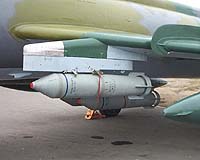
Moscow, Russia (AFP) Dec 06, 2004 Russia revealed Monday it was fitting its strategic bombers with cruise missiles - capable of delivering massive precision strikes thousands of kilometers away - giving the first clear hint of its post-Cold War military strategy. "Russia's long-range air force finally has a new weapon," the government's Rossiyskaya Gazeta daily announced in a headline. "We now have a strategic cruise missile with a non-nuclear warhead," the paper wrote "We have broken the US monopoly on the use long-range conventional cruise missiles," an unnamed senior air force commander told ITAR-TASS. The technology appears to be similar to cruise missiles that the United States has long attached to its own intercontinental bombers like the B-2 Stealth bomber. The announcement followed months of cryptic statements from President Vladimir Putin and his top generals that Russia was developing a new missile program that is a step ahead of any Western rivals - including technology developed by the United States. Putin declared last month that Russia had "conducted tests of the latest nuclear rocket systems" in a cryptic comment that puzzled military strategists but seemed aimed at Washington and its mooted missile defense shield that Moscow considers illegal. Russia has been developing a range of new missiles capable of penetrating US defenses as a result. Generals announced earlier this year the successful tests of a hypersonic intercontinental missile that has no officially-confirmed rival in the United States. Moscow is also believed to be developing a multi-stage intercontinental ballistic missile that uses cruise missile technology to zigzag and avoid being shot down once it re-enters the earth's atmosphere. Finally Russia announced that it was making its most feared and powerful trans-Atlantic missile mobile within the next two years. But the latest technology announced Monday would see old Soviet-era conventional missiles be carried by strategic bombers with a global range. The Russian government daily said tests of the new system were being conducted in military exercises now under way in southern Russia. "This year, our strategic Tu-160 and Tu-95s bombers have been equipped with new non-nuclear precision weapons," ITAR-TASS quoted an unnamed Russian air force general as saying. "These cruise missiles have a range of more than 3,000 kilometersmiles) and can miss a target by no more than a few meters while carrying a warhead of hundreds of kilotons," the source said. The report failed to specify the type of missile being used. The bombers currently carry an intercontinental ballistic missile called X-55 (AS-15 Kent according to Western classification) that was first deployed in 1983. But Russian news reports said at least some of the planes will now be re-equipped with a new smaller missile which in Russian is called OFAB-500 and which carries a massive cluster bomb weighing 515 kilograms (1,130 pounds). The pudgy weapon only has a top speed of 1,200 kilometers (720 miles) an hour but would be launched from bombers that can reach any spot on earth. A military source told ITAR-TASS the first Tu-160 has been equipped with 45 tons of bombs - or about 90 missiles. "These new cruise missiles are a very precise weapon," the Krasnaya Zvezda (Red Star) official defense ministry newspaper wrote. "The crew will be capable of delivering, as they say, a 'present' through an open window," the paper said. However the Russian government daily pointed out that Moscow has a long way to go before it can catch up with Washington. Rossiyskaya Gazeta estimated said the United States now has 5,000 non-nuclear-tipped cruise missiles with up to 700 of them attached to global B-52 and B-2 bombers. The unnamed general told ITAR-TASS that Russia's technology was primarily aimed for "anti-terrorist operations" rather than a major war. All rights reserved. � 2004 Agence France-Presse. Sections of the information displayed on this page (dispatches, photographs, logos) are protected by intellectual property rights owned by Agence France-Presse. As a consequence, you may not copy, reproduce, modify, transmit, publish, display or in any way commercially exploit any of the content of this section without the prior written consent of Agence France-Presse. Community Email This Article Comment On This Article Related Links SpaceDaily Search SpaceDaily Subscribe To SpaceDaily Express Learn about missile defense at SpaceWar.com All about missiles at SpaceWar.com
 Northrop Grumman Wins Contract For Target And Space-Launch Missile Work
 Reston VA (SPX) Jan 12, 2006
Northrop Grumman has been awarded a follow-on contract to provide technical support to the U.S. Air Force's Rocket Systems Launch Program (RSLP). |
|
|

| The content herein, unless otherwise known to be public domain, are Copyright 1995-2006 - SpaceDaily.AFP and UPI Wire Stories are copyright Agence France-Presse and United Press International. ESA PortalReports are copyright European Space Agency. All NASA sourced material is public domain. Additionalcopyrights may apply in whole or part to other bona fide parties. Advertising does not imply endorsement,agreement or approval of any opinions, statements or information provided by SpaceDaily on any Web page published or hosted by SpaceDaily. Privacy Statement |