|
 |
 |
 |
 |
 |
 |
 |
 |

 |
Russia Plans New Nuclear Missile Production
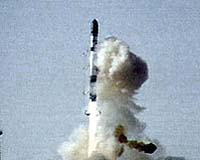
Moscow (AFP) Aug 05, 2007 The Russian Navy announced Sunday it will produce a series of intercontinental missiles for its next generation of nuclear submarines. "The last test trial of the Bulava-M at the end of June was very important ... After examining the results we decided to start work on these missiles for our new armament system," navy chief Admiral Vladimir Marossin told Russian news agencies. The Bulava-M missile, with a range of more than 8,000 kilometres (4,970 miles) can hold up to 10 nuclear warheads. "The success of the last test trial gave us the possibility to commission the production of a series of missiles," Marossin said. The two Bulava-M missile tests were made in 2007 and the others would be made next year. The Russian navy plans to finish all its tests of the new system in 2008. "We hope that during the testing we will decide to put the missile into service in 2008," said Marossin. The first Bulava missile test was made in September 2005. Three Bulava-M trials in 2006 failed, but at least 10 more missile trials are scheduled for 2008. Bulava-M, the sea version of the sophisticated surface-to-surface missile Topol-M, will be fitted for nuclear submarine launchers with engine type 955. Yuri Dolgorukii, the first example of this type of submarine was launched in April 2007. Russia wants to make eight fleet ballistic missile submarines (SSBN) with Bulava technology between now and 2018. The two submarines of this generation, the Alexander Nevskii and the Vladimir Monomakh, which come after the Dolgorukii, should be up and running in 2009 and 20011, respectively. In addition to the Bulava-M missile tests, Russia announced at the end of May that they successfully tested the RS-24, a new interncontinential missile with multiple warheads adopted by Topol-M, which was presented up to now as the first response to the American anti-missile shield project. The Russians have condemned a US anti-missile shield planned for eastern Europe despite US assurances it is only intended to counter "rogue states" such as Iran.
Source: Agence France-Presse Community Email This Article Comment On This Article Related Links Learn about nuclear weapons doctrine and defense at SpaceWar.com Learn about missile defense at SpaceWar.com All about missiles at SpaceWar.com Learn about the Superpowers of the 21st Century at SpaceWar.com
 Pakistan Says US-India Nuke Deal Risks Arms Race
 Islamabad (AFP) Aug 02, 2007
Pakistan warned Thursday that a civilian nuclear accord between India and the United States threatens regional stability, saying it would allow its arch rival to produce more atomic bombs. The caution came at a meeting of Pakistan's National Command Authority (NCA) chaired by President Pervez Musharraf, a statement said. The body oversees the country's nuclear strategy. The long-delayed deal announced in July in Washington allows US exports of civilian nuclear fuel and technology to India for the first time in 30 years. |
|
|

| The content herein, unless otherwise known to be public domain, are Copyright 1995-2007 - SpaceDaily.AFP and UPI Wire Stories are copyright Agence France-Presse and United Press International. ESA Portal Reports are copyright European Space Agency. All NASA sourced material is public domain. Additional copyrights may apply in whole or part to other bona fide parties. Advertising does not imply endorsement,agreement or approval of any opinions, statements or information provided by SpaceDaily on any Web page published or hosted by SpaceDaily. Privacy Statement |