|
 |
 |
 |
 |
 |
 |
 |
 |

 |
Russia Hails US Nuclear Initiative To Stop Proliferation
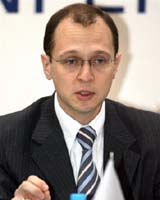
Vienna (RIA Novosti) Sep 18, 2006 Russia's nuclear chief said Monday that Moscow welcomed a proposal made by the United States on global partnership as another step toward securing non-proliferation in the nuclear sector. Sergei Kiriyenko, the head of the Federal Agency for Nuclear Power, also said Russia paid close attention to and praised work conducted by the International Atomic Energy Agency, the UN's nuclear watchdog, on identifying undisclosed nuclear materials and covert activities. "We support the U.S. initiatives on global nuclear energy partnership and proposals from a group of largest suppliers of enriched uranium on guaranteed supplies," Kiriyenko said after the 50th IAEA General Conference in Vienna, Austria. According to the U.S. Department of Energy, the Global Nuclear Energy Partnership, which is part of President George Bush's Advanced Energy Initiative, seeks to develop carbon-free nuclear energy to meet growing electricity demand by using a nuclear fuel cycle that enhances energy security while promoting non-proliferation. It focuses on recycling and providing assistance to nations pursuing nuclear energy for civilian needs alone. Kiriyenko also said he agreed with U.S. Energy Secretary Samuel Bodman, who said U.S. President Bush's initiative on nuclear partnership was a supplement to Russian proposals. "It is very important that President Bush's initiative supplement President [Vladimir] Putin's initiatives in the sphere of global nuclear energy cooperation," he said. Putin suggested at the beginning of the year that international uranium enrichment centers be set up in Russia in a move that was widely interpreted as an attempt to reach a compromise in the crisis over Iran's nuclear ambitions. Bodman had told the conference earlier that American-Russian cooperation in the nuclear sector was developing in every important respect. Last Friday, the countries signed a liability agreement under which the U.S. and Russia would dispose of 68 metric tons (about 150,000 pounds) of weapons-grade plutonium by converting it into fuel for commercial reactors. Bodman also said the countries were successfully implementing the HEU-LEU conversion program, as well as a program on returning highly enriched uranium to Russia from a number of countries. The move is part of a Russian-U.S. intergovernmental agreement on cooperation in returning nuclear fuel from Russian-made research reactors, signed in May 2004, and a joint statement on nuclear security signed by presidents George Bush and Vladimir Putin during a meeting in Bratislava in February 2005. Since 2004, Russia has repatriated new highly enriched uranium from Soviet-built plants in eight countries: Serbia and Montenegro, Romania, the Czech Republic, Bulgaria, Libya, Latvia, Poland and Uzbekistan. IAEA Control Kiriyenko also praised the UN's atomic watchdog, which is headed by Director General Mohamed ElBaradei, for its efforts to maintain the nonproliferation regime. "Russia attaches great importance to the IAEA's work on improving its control activities, including the development of the IAEA abilities to discover undisclosed nuclear materials and activities," he said. IAEA inspectors have been at the forefront of efforts to clarify the nuclear-status of countries such as Iraq, Iran and North Korea in recent years. Russia is continuing to help build a controversial nuclear power plant in Iran, which has consistently said it needs atomic energy for civilian needs rather than a covert arms program, and has called on Tehran to cooperate with the Vienna-based organization. Kiriyenko, who served a brief term as prime minister under President Boris Yeltsin in 1998, was also upbeat about a mooted system of nuclear-fuel services as more and more countries opted to pursue nuclear energy, but he added that the system should be under strict control of the IAEA. He said the expansion of nuclear energy technologies was accompanied by the threat that nuclear energy could be used for military purposes. This problem, he said, could be solved by a Russian initiative to form a global nuclear energy infrastructure that would provide equal access on market terms for all countries to nuclear energy under regulation and standards of non-proliferation. "The key element of such infrastructure is a system of international centers on nuclear fuel cycle services under the control of the IAEA," Kiriyenko said. Earlier this month he said that Russia could control up to 25% of the world's nuclear-fuel services market. "Russia believes that 25% of the world's market in nuclear fuel-cycle services, including uranium enrichment, is an optimal share," Kiriyenko said. "Technically and technologically, we are well positioned for this."
Russia-US Nuclear Cooperation Progresses Says US Energy Secretary Samuel Bodman said that Russia and the United States enhanced the security of hundreds of tons of material for weapons, and that they planned to complete the work in 2008. "This agreement demonstrates that both countries continue to be committed to this important nonproliferation program, which will dispose of enough weapons-grade plutonium for more than 16,000 nuclear weapons," Bodman said following the signing Friday. Bodman also said the countries were successfully implementing the HEU-LEU conversion program, as well as the program on the repatriation of highly enriched uranium to Russia from a number of countries. The repatriation is part of a Russian-U.S. intergovernmental agreement on cooperation in returning nuclear fuel from Russian-made research reactors, signed in May 2004, and a joint statement on nuclear security signed by presidents George Bush and Vladimir Putin during a meeting in Bratislava in February 2005. Since 2004, Russia has repatriated new HEU from Soviet-built plants in eight countries -- Serbia and Montenegro, Romania, the Czech Republic, Bulgaria, Libya, Latvia, Poland and Uzbekistan.
Source: RIA Novosti Community Email This Article Comment On This Article Related Links Learn about nuclear weapons doctrine and defense at SpaceWar.com Learn about nuclear weapons doctrine and defense at SpaceWar.com Learn about missile defense at SpaceWar.com All about missiles at SpaceWar.com Learn about the Superpowers of the 21st Century at SpaceWar.com
 North Korea Progress Unlikely
 Washington (UPI) Sep 18, 2006
While U.S. President George Bush was meeting President Roh, his South Korean counterpart, last week in Washington, North Korean officials were preparing to attend the summit meeting of the Non-Aligned Movement of nations which was held in Havana, Cuba over the weekend. |
|
|

| The content herein, unless otherwise known to be public domain, are Copyright 1995-2006 - SpaceDaily.AFP and UPI Wire Stories are copyright Agence France-Presse and United Press International. ESA PortalReports are copyright European Space Agency. All NASA sourced material is public domain. Additionalcopyrights may apply in whole or part to other bona fide parties. Advertising does not imply endorsement,agreement or approval of any opinions, statements or information provided by SpaceDaily on any Web page published or hosted by SpaceDaily. Privacy Statement |